

Queens has more co-op apartments for sale per capita than almost any other place in the country. The wave started in the 1970s and 1980s, when New York's fiscal crisis pushed landlords to convert rental buildings into cooperatives and sell shares to tenants. Queens — with its enormous stock of postwar apartment buildings — was ground zero. Today, co-ops make up roughly 24.6% of all residential sales in the borough, with around 994 active co-op listings at any given time.
If you're a first-time buyer searching for a co-op for sale near me in Queens, understanding exactly how co-ops differ from condos will save you months of wasted time — and potentially thousands in financing mistakes. For buyers already familiar with the condo side of the market, our Queens condo buyer's guide covers the full condo landscape for comparison.
What a Co-op Actually Is (and Why Queens Has So Many)
Most first-time buyers assume they're purchasing an apartment. In a co-op, you're buying stock.
When you purchase a Queens co-op, you receive shares in the building's corporation and a proprietary lease — the legal document that gives you the right to occupy your specific unit. You don't get a deed. You don't technically own the walls around you. The corporation does. According to the New York State Attorney General's cooperative housing guidance, this share-based ownership structure is what makes co-ops fundamentally different from condominiums under state law.
This structure has real consequences for your daily life:
- Renovation: Want to gut-renovate your kitchen? You need board approval and typically an alteration agreement.
- Subletting: Want to rent the apartment while you travel for work? The board has rules about that — and often prohibits it for the first one to two years.
- Selling: Your buyer needs the board's blessing too, even after the 2026 Clock Law.
Co-op vs. Condo: What Actually Matters
| Feature | Co-op | Condo |
|---|---|---|
| Ownership | Shares + proprietary lease | Deed to unit |
| Queens median price | ~$330K | ~$650K+ |
| Down payment | 20–30% (board-set) | Typically 10% |
| Closing costs | 1–3% ✓ | 4–6% |
| Mortgage recording tax | Exempt ✓ | 1.8–1.925% |
| Title insurance | Not required ✓ | Required |
| Board approval to buy | Required | No (ROFR rarely exercised) |
| Board approval to sell | Required | No |
| Subletting | Restricted or prohibited (1–2 yr wait) | Generally unrestricted |
| FHA/VA eligible | Rarely (building must qualify) | Rarely (NYC right-of-first-refusal) |
The savings on closing costs are real and immediate. Co-op buyers skip the mortgage recording tax (1.8–1.925% of the loan) and title insurance (~0.45% of the purchase price). On a co-op averaging around $330,000 compared to a condo at a similar size, that's roughly $6,000 to $10,000 in savings at closing alone. For a full breakdown of NYC closing costs across property types, see our NYC closing costs guide.
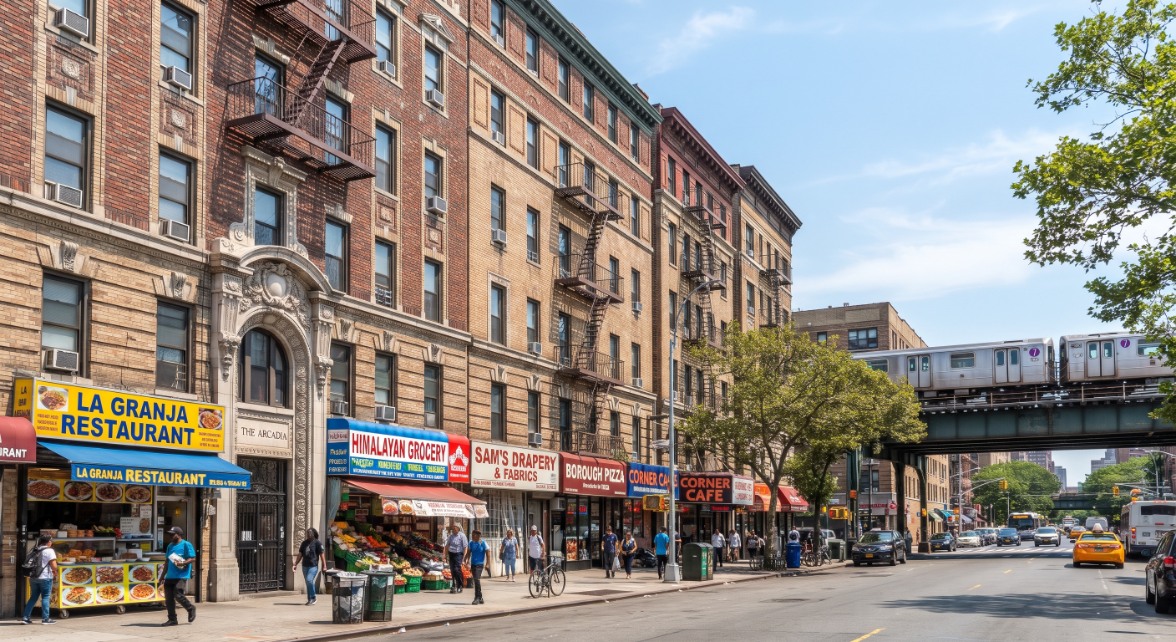
Queens Co-op Prices by Neighborhood: 2026–2027
The borough-wide median for Queens co-ops averages around $330,000 as of late 2026 — up approximately 2.4% year over year from around $322,000 in 2024, with 2027 trends pointing modestly higher. That single number hides enormous variation. Not sure how Queens neighborhoods connect geographically? The Queens neighborhood map covers all 90+ areas with prices and transit by zone.
Budget Tier: Jackson Heights and Rego Park
Jackson Heights remains one of the best deals in New York City. Average prices range from roughly $188,000 to $300,000 for most one-bedrooms, at around $109,000 per room. The 7 train delivers you to Midtown in about 20 minutes, and the neighborhood's restaurant density rivals anywhere in the borough. For buyers who want maximum purchasing power with a real Manhattan commute, Jackson Heights is the answer.
Rego Park averages from roughly $269,000 to $550,000 depending on size and floor, with per-room costs averaging around $88,000 — the most affordable per-room option among well-served Queens neighborhoods. The M and R trains connect to Midtown in about 40 minutes. Co-op inventory here is deep and diverse, ranging from prewar walkups to mid-century doorman buildings.
Mid Tier: Sunnyside and Astoria
Sunnyside averages from roughly $340,000 to $525,000 — a sweet spot for buyers who want neighborhood character and a quick 7-train commute without paying Forest Hills prices. Astoria has climbed in recent years, averaging roughly $450,000 to $530,000. You're paying for the restaurant scene, waterfront access, and N/W train proximity. Inventory in Astoria moves quickly — well-priced listings routinely go into contract within days.
Premium Tier: Forest Hills and Long Island City
Forest Hills averages from roughly $500,000 to $700,000-plus, primarily prewar buildings near Austin Street and the Gardens neighborhood. School District 28 (including Queens High School for the Sciences, ranked among the top in New York State) makes Forest Hills a strong choice for families. Long Island City tops the chart, averaging from roughly $650,000 to $800,000-plus for newer conversions with Manhattan views and one-stop subway access to Midtown.
For a full ranking by affordability, the most affordable neighborhoods in Queens guide covers 13 areas with entry-price data and down payment assistance details.
Monthly Maintenance: What You're Actually Paying For
The purchase price is only half the equation. Maintenance is the bill that never stops — and it can vary by hundreds of dollars per month between buildings of similar size in the same neighborhood.
- Studio: roughly $450 to $800 per month
- One-bedroom: roughly $600 to $1,200 per month
- Two-bedroom: roughly $900 to $1,800 per month
What Maintenance Covers
Your monthly maintenance check covers the building's operating costs, split proportionally among all shareholders based on share count. That includes the building's portion of property taxes, insurance, staff salaries (doorman, super, porters), common area maintenance, and the building's underlying mortgage payments if one exists.
In many Queens co-ops — particularly older postwar buildings in Forest Hills, Rego Park, and Jackson Heights — maintenance also bundles utilities that condo owners pay separately. Heat, cooking gas, and hot water are frequently included. A building that includes all utilities at $900 per month may cost less per month than a condo with $600 in common charges plus $350 in utilities.
Four Factors That Drive the Spread
- Building age: Older buildings need more ongoing repairs and capital projects.
- Staffing level: A full-time doorman building costs significantly more than a walk-up.
- Underlying mortgage: Buildings still paying off their original conversion loan pass that cost directly to shareholders.
- Reserve fund health: A well-funded reserve absorbs surprises without special assessments; a depleted one doesn't.
Watch Out for Special Assessments
On top of monthly maintenance, the board can levy special assessments for major capital projects — a new roof, elevator modernization, or facade repair. These can add anywhere from around $200 to $400 per month per unit for 12 to 18 months, or more for larger projects. NYC's Local Law 11 requires facade inspections every five years, and buildings that fail must fund repairs immediately.
Before making any offer, ask the managing agent two questions: Are there any current assessments? Are any capital projects planned in the next two years? Factor any upcoming work into your monthly budget projections.
A good agent flags maintenance increases and planned assessments before you make an offer — not after you're under contract.
Match with a licensed Queens co-op specialist today — free, no commitment.
Mon – Sat · 9 AM – 7 PM ET
Financial Requirements: Down Payment, Credit, and the Reserve Rule
The money requirements for a co-op are stricter than for a condo — and they're set by the individual board, not by a lender. Every building operates on slightly different thresholds, but these ranges apply to the majority of Queens co-ops in 2026.
Down Payment
Plan on a minimum of 20%. Many Queens co-ops in well-maintained postwar buildings require 25 to 30%, especially those with conservative boards. On a co-op averaging around $330,000, that's roughly $66,000 to $99,000 upfront before closing costs.
If you need help reaching that threshold, the NYC HPD HomeFirst Down Payment Assistance Program offers up to $100,000 as a forgivable loan. Gift letters from family members are accepted by most boards, but some require documentation that the gift carries no repayment obligation. For a complete guide to stacking programs, see our NYC down payment assistance guide.
Credit Score
Most boards want a minimum credit score of 680. To be genuinely competitive, aim for 720 or above. Scores below 680 don't necessarily disqualify you, but they make the board interview a significantly harder conversation — and give the board a reason to slow down their review.
Debt-to-Income Ratio
Boards typically want your total housing costs — maintenance, mortgage, and any assessments — to fall within 28 to 33% of your gross monthly income. On a co-op averaging around $330,000 with a 20% down payment, that translates to roughly $6,000 to $7,000 in minimum gross monthly income. Some buildings calculate this differently, so ask your broker about specific board thresholds before you apply to a building.
Post-Closing Liquidity: The Requirement That Blindsides Most First-Timers
After your down payment and closing costs, boards want to see 12 to 24 months of mortgage and maintenance payments sitting in liquid assets — cash, stocks, or bonds you can access quickly. Retirement accounts typically count at 50 to 70% of their value, depending on the board.
Closing Costs: The Advantage Over Condos
Co-op closing costs run just 1 to 3% of the purchase price. You skip mortgage recording tax (which is 1.8 to 1.925% of the loan on condos) and title insurance (because there's no property title to insure). On a co-op purchase averaging around $330,000, expect roughly $3,300 to $9,900 in total closing costs. That's dramatically below what condo buyers pay.
Board Approval and the 2026 Clock Law
Every co-op buyer in Queens faces the board. As of July 2026, the board now faces a deadline too.
The Board Package
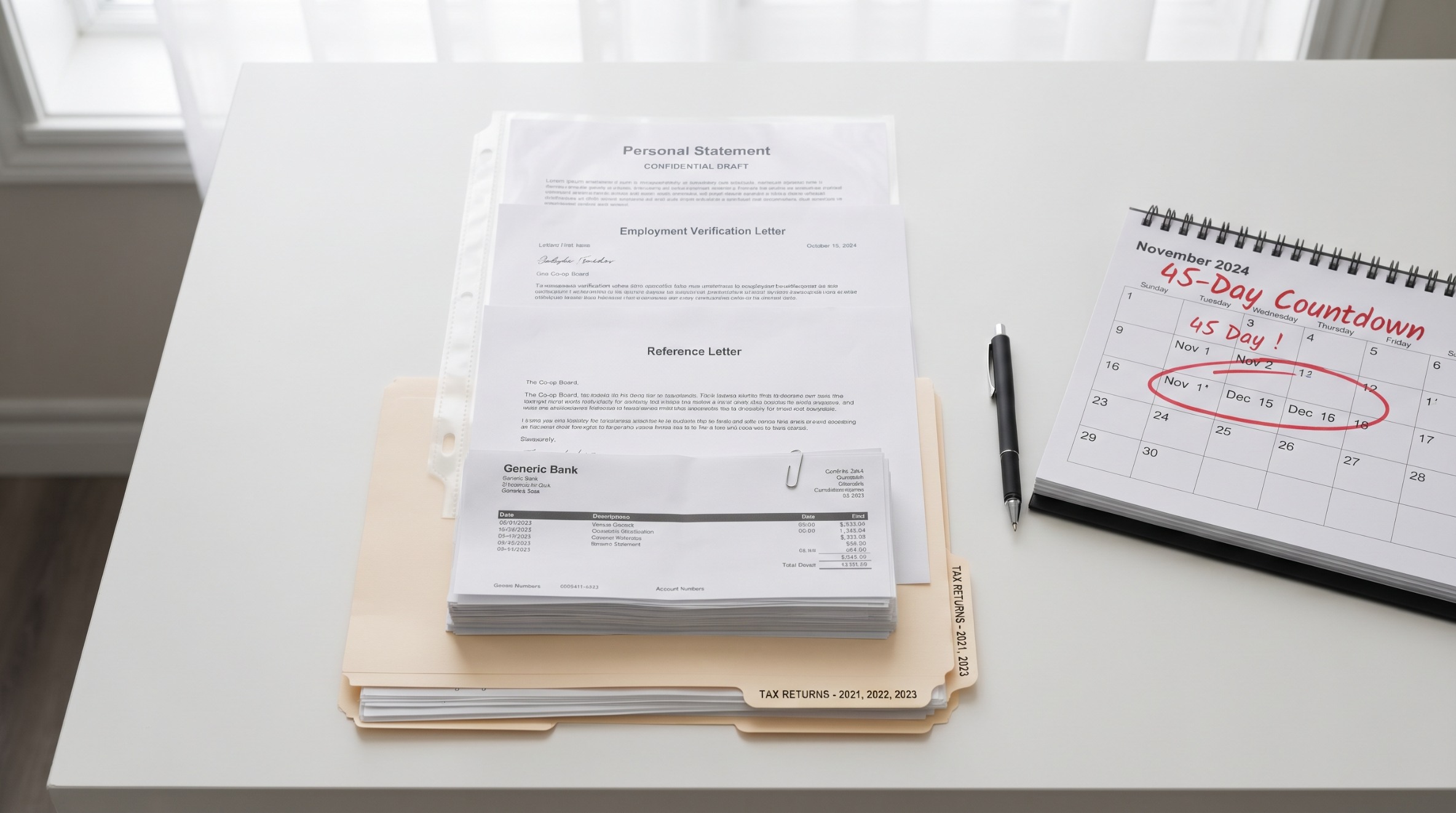
Your application package is essentially a financial biography. Queens co-op boards typically require:
Board Package Checklist
- Two to three years of personal tax returns (all pages, all schedules)
- Recent bank statements (last 2–3 months, all accounts)
- Recent investment and retirement account statements
- Employment verification letter on company letterhead
- Two to three personal reference letters
- Two to three professional reference letters
- Personal statement: why you want to live in this specific building
- Signed purchase application and building-specific forms
Submit everything at once. Incomplete packages are returned — and the Clock Law's 15-day acknowledgment window starts only when the package is deemed complete.
For an in-depth guide to building the strongest possible package, including what boards are secretly evaluating, see our NYC co-op board approval guide.
The Interview
Not every Queens co-op requires a board interview, but many larger and professionally managed buildings do. Expect a 15 to 30 minute conversation with two to five board members. Topics typically cover your work situation, finances, daily schedule, and why you want to live in this particular building. Dress business casual. Know your financial numbers cold — mortgage payment, maintenance, and monthly income. Have a clear, concise answer for how long you plan to stay.
Local Law 58: The 2026 Clock Law
Before this law, co-op boards could sit on applications for months with no accountability. That era is over — at least partially.
Under Local Law 58:
- The board must acknowledge a complete application within 15 days. Fail to do so and the application is automatically deemed complete.
- The board has 45 days from a complete application to issue a decision.
- The board may request one 14-day extension, bringing the maximum to 59 days.
The law has real limits. It does not apply to HDFC co-ops, Mitchell-Lama buildings, or co-ops with fewer than 10 units. And critically, boards still do not need to explain a rejection. The right to reject without reason remains fully intact.
Queens co-op boards typically processed applications in 3 to 4 weeks even before this law — noticeably faster than Manhattan's historical 6 to 8 week standard. The Clock Law matters most for buyers dealing with slower buildings or those deliberately stalling.
Rejection Rates Are Climbing
Historically, co-op boards rejected only 3 to 5% of applicants across NYC. That rate has been creeping upward through 2025 and 2026 as rising maintenance costs and underfunded reserves make boards more selective. They want financially bulletproof shareholders who can absorb future increases without trouble. If you're right at the minimum thresholds for credit, DTI, or post-closing liquidity, expect a longer and harder review.

How to Read a Co-op's Financial Statement Before You Buy
You wouldn't buy a car without checking under the hood. A co-op's financial statements are the hood. Your attorney reviews these in detail, but knowing what to look for yourself helps you filter out problem buildings before you waste weeks on an application.
Focus on four numbers:
1. Current Ratio
Divide the building's current assets by its current liabilities. You want at least 1:1. Below that threshold, the building may struggle to pay its near-term bills. Well-run buildings typically sit at 1.5:1 or higher.
2. Reserve Fund
The reserve fund is the building's rainy-day account. It should hold a minimum of 10% of the building's annual operating budget — that's the threshold Fannie Mae uses when deciding whether to back mortgages in the building. Below 10%, lenders may refuse to finance purchases entirely, which tanks resale value and shrinks your eventual buyer pool. Ask your attorney to track whether the reserve has been growing or shrinking over the past three years.
3. Underlying Mortgage
Many co-op buildings still carry a mortgage from the original conversion. Check when it matures and at what interest rate. If a building's mortgage locked at a low rate and is set to refinance at a much higher current rate, that difference could add hundreds of dollars per month to every unit's maintenance. This is the single largest hidden cost in co-op ownership and is often completely missed by first-time buyers.
4. Operating Expense Trend
Pull three to five years of financial statements and track how fast expenses are growing. Healthy buildings keep increases to around 2% per year. If expenses are climbing 5 to 8% annually, maintenance hikes are coming — and a building above 5% sustained growth with a reserve below 10% is a serious red flag no matter how attractive the apartment looks.

HDFC Co-ops and Sponsor Units: Two Paths Worth Knowing
HDFC Co-ops: Below-Market Prices with Income Caps
HDFC (Housing Development Fund Corporation) co-ops were created specifically to preserve affordable housing in New York City. They sell at well below market prices and carry a partial property tax exemption that keeps maintenance unusually low compared to standard co-ops.
The catch is an income limit. In 2026 and 2027, that cap reaches up to 165% of the Area Median Income — working out to roughly $196,000 per year for a single person. If you earn under that threshold, you could buy an apartment at a fraction of the standard market rate in neighborhoods like Jackson Heights, Rego Park, and Woodside.
The trade-off is significant: resale price caps limit how much equity you can build. When you sell, the maximum price is set by a formula, not the open market. You'll build some wealth — but not at the same pace as a standard co-op owner. HDFC inventory in Queens is limited, and waitlists for popular buildings can stretch months. The Clock Law also does not apply to HDFC co-ops.
Sponsor Units: Skip the Board Entirely
Sponsor units are apartments still held by the original developer or building conversion sponsor. The key advantage: no board approval required. You purchase directly from the sponsor, and the board cannot block the transaction.
You'll pay for that convenience. Sponsor units typically carry a 5 to 10% price premium over comparable resale units in the same building. The buyer (not the seller) also pays transfer taxes, adding to closing costs. However, sponsor units can qualify for up to 97% loan-to-value financing, compared to the standard 80% for resale co-ops — meaning a down payment as low as 3% instead of 20%. For buyers with strong income but limited savings, this math can work in your favor.
Remaining sponsor units in Queens are concentrated in prewar buildings in Rego Park, Forest Hills, and Astoria. When one appears, it moves fast. Set alerts with your broker to hear about listings within hours.
House Rules: Pets, Subletting, and Renovation Limits
The house rules can make or break your quality of life in a co-op. Read them before you sign anything. They're not negotiable after closing.
Pet Policies
Queens co-ops fall into three tiers: buildings that ban pets entirely, buildings that allow them on a case-by-case basis with board approval, and buildings that allow pets with minimal restrictions. Weight limits (commonly 30 to 35 pounds for dogs) and breed restrictions (often excluding pit bulls, Rottweilers, and Dobermans) are standard across mid-tier and premium buildings.
One critical detail most buyers miss: co-op shareholders do not have the same pet protections as renters. New York's 90-day pet law — which prevents landlords from evicting tenants who've openly kept a pet for three months — does not apply to co-op owners. If your building bans pets and the board discovers yours, they can demand removal with no grace period. Verify the policy before you fall in love with a unit.
Sublet Rules
Most Queens co-ops allow subletting under specific conditions: a minimum owner-occupancy period of one to two years before subletting, a maximum sublet duration of one to two years, board approval for the subtenant, and a sublet fee. Some buildings ban subletting entirely. If rental income flexibility is important to your financial plan, verify the sublet policy before making an offer — after contract is too late. For context on how this compares to the condo side, see our co-op vs. condo selling comparison.
Renovation Restrictions
Anything beyond paint and minor cosmetic work requires board approval. Structural changes, kitchen and bathroom renovations, and flooring replacements typically need an architect's plan, a licensed contractor, and a signed alteration agreement. The approval process can take weeks to months. Factor these timelines into your plans if you're purchasing a unit that needs significant work.
Down Payment Assistance for Queens Co-op Buyers
New York City offers first-time co-op buyers genuine financial help — programs that most buyers don't discover until after they've already closed.
Forgiven over 10–15 years of owner-occupancy. Income limit ~$90K for a family of three (80% AMI). Apply early — funding cycles close fast. Co-ops qualify.
nyc.gov/hpd · HomeFirst programBelow-market-rate mortgage plus a down payment loan. First-time buyers with income under ~$172K. Can be combined with HomeFirst for maximum assistance.
sonyma.org3% down on conventional loans with reduced PMI. Works on co-ops that qualify for conventional financing. Combine with SONYMA for maximum leverage.
Available through most lendersThese programs can be stacked. A qualifying buyer could potentially layer HomeFirst ($100K), SONYMA DPAL ($15K), and a HomeReady mortgage together. For full stacking rules, income limits, and step-by-step application guidance, see the NYC down payment assistance guide. For a broader look at what first-time buyers qualify for in Queens, the Queens first-time home buyer guide covers every available program with eligibility checklists.
Property taxes are another ongoing cost of ownership once you close. Understanding how Queens co-op taxes work — and which exemptions apply — can reduce your monthly costs meaningfully. Our Queens property taxes guide walks through the full calculation and appeal process.
We help first-time co-op buyers in Queens navigate the board package, financial requirements, and down payment programs — start to close.
Match with a licensed Queens co-op specialist today — no cost, no commitment.
Mon – Sat · 9 AM – 7 PM ET
Frequently Asked Questions
How much does a co-op cost in Queens, NY?
The borough-wide median for Queens co-ops averages around $330,000 as of late 2026. Prices range from averages of $188,000 to $300,000 for one-bedrooms in Jackson Heights to $650,000–$800,000-plus in Long Island City. Queens remains the most affordable co-op market in New York City by a wide margin compared to Manhattan, where medians run two to three times higher.
What is the 2026 Clock Law for co-op boards?
Local Law 58, effective July 28, 2026, requires co-op boards to acknowledge a complete application within 15 days and issue a decision within 45 days (with one 14-day extension). It does not apply to HDFC co-ops, Mitchell-Lama buildings, or co-ops with fewer than 10 units. Boards still may reject applicants without stating a reason.
How much down payment do I need for a Queens co-op?
Most Queens co-ops require at least 20% down; many boards in well-maintained buildings require 25 to 30%. On a co-op averaging around $330,000, that's roughly $66,000 to $99,000 before closing costs. NYC's HomeFirst program can provide up to $100,000 in forgivable assistance for qualifying first-time buyers. Sponsor units can qualify for as little as 3% down, skipping board approval entirely.
How long does it take to buy a co-op in Queens?
Expect two to three months from accepted offer to closing. That breaks down to roughly two weeks for mortgage approval, two to four weeks for board review (now capped at 45 days under Local Law 58), and two to three weeks for closing logistics. Incomplete applications or financing complications can extend the timeline significantly.
Can I rent out my Queens co-op?
Usually yes, with conditions. Most Queens co-ops allow subletting after one to two years of owner-occupancy. You'll typically need board approval for your subtenant and will likely pay a sublet fee. Some buildings ban subletting entirely. Always read the proprietary lease before assuming you can rent — check before making an offer, not after contract.
What is an HDFC co-op in Queens?
HDFC (Housing Development Fund Corporation) co-ops sell at well below market prices and carry a partial property tax exemption that keeps maintenance low. Income caps apply — up to roughly 165% of AMI in 2026, around $196,000 for a single person. Resale price caps limit equity growth, and the 2026 Clock Law does not apply to HDFC buildings. Limited inventory; work with a broker experienced in HDFC transactions.
What are co-op closing costs in Queens?
Co-op closing costs typically run 1 to 3% of the purchase price. Co-op buyers skip the mortgage recording tax (1.8–1.925% of the loan on condos) and title insurance — two of the largest condo closing cost items. On a purchase averaging around $330,000, expect roughly $3,300 to $9,900 in total closing costs. That's $6,000 to $10,000 less than a comparable condo purchase.
What happens if the co-op board rejects me?
Your contract deposit is returned in full. Under the 2026 Clock Law, the board still does not need to state a reason for rejection. You can reapply to the same building, but most experienced brokers advise against it unless your financial situation has materially changed. Work with your broker to identify buildings better matched to your specific financial profile before applying broadly.
I'm searching "co-op for sale near me" in Queens — where do I start?
Start with your commute corridor, then filter by price and bedroom count. Neighborhoods along the 7 train (Jackson Heights, Sunnyside, Woodside), the E/F/M/R trains (Forest Hills, Rego Park, Kew Gardens), and the N/W trains (Astoria) hold the majority of Queens co-op inventory. Set saved searches on StreetEasy to get alerts on new listings the day they appear. Then use the per-room prices in this guide to compare apples-to-apples across neighborhoods.
Sources & References
- 1 StreetEasy Queens Co-op Listings & Market Data
- 2 NYC HPD — HomeFirst Down Payment Assistance HomeFirst Program Details
- 3 New York State Attorney General — Real Estate Finance Bureau Cooperatives and Condominiums Guidance