

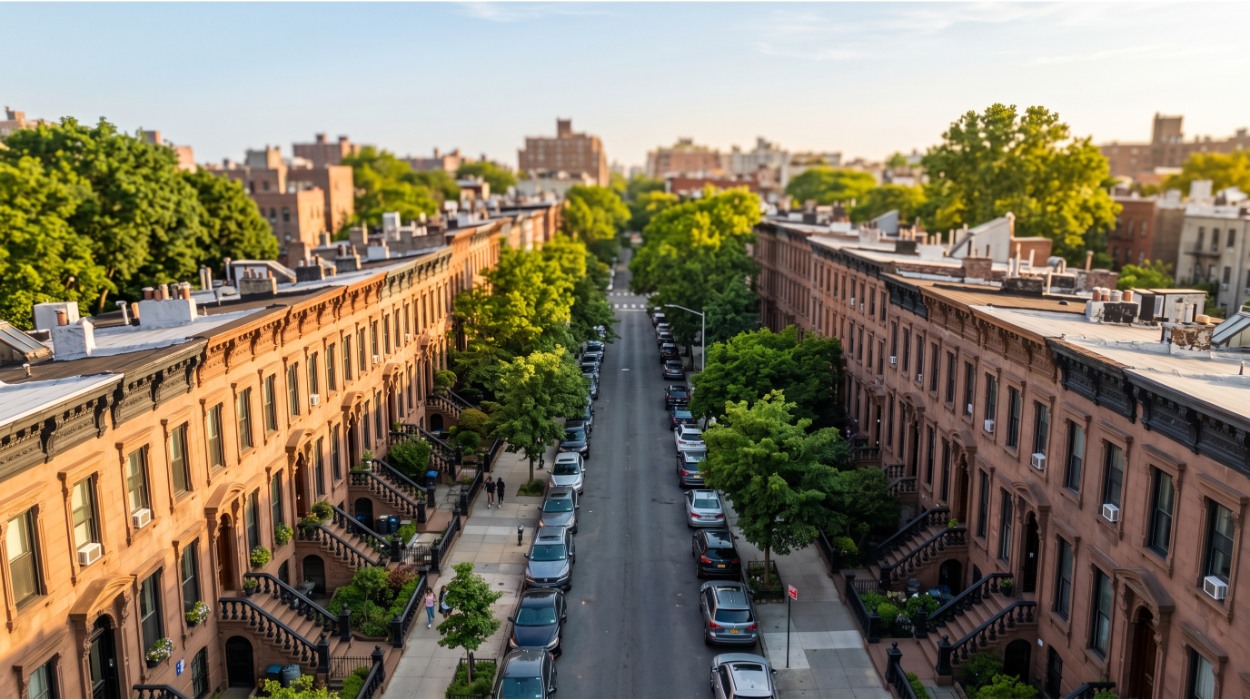


If you're financing a home purchase or a refinance anywhere in New York City, the mortgage recording tax is one of the biggest single closing-cost line items you'll see, and it catches a lot of first-time buyers by surprise because it's a tax on the loan, not on the price of the home. It's owed whenever a mortgage is recorded against real property in the city, collected through the Automated City Register Information System (ACRIS) in Queens, Brooklyn, Manhattan, and the Bronx, and through the Richmond County Clerk on Staten Island.1
The rate depends on how much you're borrowing, not what you're buying for, and it applies differently depending on whether you're closing on a house, a condo, or a co-op. This guide covers the combined city and state rates for 1-, 2-, and 3-family homes and condos, how the tax splits between you and your lender, why a co-op loan skips the tax entirely, how a consolidation, extension and modification agreement (CEMA) can cut what you owe on a refinance or certain purchases, worked examples using only published rates, and how the tax fits alongside the state's mansion tax and your other closing costs.
Every figure below comes from the New York State Tax Law text, the New York State Department of Taxation and Finance, or the New York City Department of Finance, plus a small number of law-firm and CPA explainers used only to fill in worked examples and typical fee ranges. Rules and rates can change, so treat the year on each figure as part of the fact.
What the Mortgage Recording Tax Actually Taxes
New York's mortgage recording tax isn't one tax; it's a stack of several, all triggered by the act of recording a mortgage against real property in the state, and all set out in Section 253 of the New York Tax Law: a statewide basic tax of fifty cents for each $100 of the principal debt (0.50%), a statewide special additional tax of twenty-five cents for each $100 (0.25%), and a statewide additional tax that runs thirty cents for each $100 (0.30%) inside the Metropolitan Commuter Transportation District, which covers all five boroughs.2 On top of those state layers, New York City imposes its own additional tax under a separate provision, Section 253-a, aimed specifically at cities of one million people or more.3
Because it's a tax on the mortgage document itself, it applies the same way whether you're buying a house in Queens, closing on a condo, or pulling cash out with a refinance, as long as a new mortgage is being recorded against the property.1 A co-op purchase is the one common exception, covered later in this guide, because a co-op loan isn't secured by a mortgage on real property at all.7
The tax is paid at closing, calculated on the principal amount of the note, and it's separate from the transfer taxes a seller (and, above $1,000,000, a buyer) also owes on the sale itself.16
Combined City and State Rates by Loan Amount
For 1-, 2-, and 3-family houses and individual condominium units, the four layers stack into two effective combined rates, split by a $500,000 threshold. Under Tax Law Sections 253 and 253-a, New York City's own portion is 1% of the loan on mortgages under $500,000, and 1.125% on mortgages of $500,000 or more, for exactly this property category.3 Added to the statewide 0.50% basic tax, 0.25% special additional tax, and 0.30% additional tax, the combined rate comes to 2.05% under $500,000 and 2.175% at $500,000 or more.23
| Loan amount | NYC portion | NYS portion | Combined rate |
|---|---|---|---|
| Under $500,000 | 1%3 | 1.05%2 | 2.05%23 |
| $500,000 or more | 1.125%3 | 1.05%2 | 2.175%23 |
Those combined rates apply the same way in Queens as in any other borough, since the mortgage recording tax is a citywide tax, not a borough-by-borough one, which matters if you're comparing financing a house in Queens against a similar purchase elsewhere in the city.3 For anyone still shopping, it's worth pricing this tax into your plan the same way you'd price in a Queens home purchase budget generally, since it's due in full at closing alongside your down payment and other costs.
Who Pays: Borrower vs. Lender
The 0.25% special additional tax isn't the borrower's to pay, at least not on the kind of property most buyers in this guide are financing. Tax Law Section 253 specifically requires that, for real property "principally improved or to be improved by one or more structures containing in the aggregate not more than six residential dwelling units," the special additional tax "shall...be paid by the mortgagee," meaning the lender.2
In practice, most lenders build that 0.25% into the deal rather than absorb it silently, but legally it isn't billed to you as a separate borrower obligation. Strip the lender's 0.25% out of the combined rates above and what's left as the borrower-paid portion is 1.80% under $500,000 and 1.925% at $500,000 or more, figures that line up with how several closing-cost guides describe what buyers actually see charged to them at the table.79
The mortgage recording tax depends less on your purchase price than on how your loan is structured, which is exactly where a CEMA or a smaller loan amount can still change the bill.
Talk through your sale with an agent, or request a free valuation of your NYC home.
Mon – Sat · 9 AM – 7 PM ET
Why Co-op Loans Are Exempt from the Mortgage Recording Tax
Co-op purchases are financed differently at a legal level, and that difference is exactly why the mortgage recording tax doesn't apply. When you buy a co-op apartment, you aren't buying real property at all; you're buying shares in the corporation that owns the building, plus a proprietary lease giving you the right to occupy your unit.7 A co-op lender secures its loan against those shares and that lease with a UCC-1 financing statement, not a mortgage recorded against a deed, so there's no mortgage being recorded and no mortgage recording tax owed.7
That's a real, structural difference, not a workaround, and it's one of several places where co-op and condo ownership diverge in ways that matter well beyond financing; see our full co-op vs. condo comparison for how that plays out on the transfer-tax and closing-cost side of a sale, too. On a $500,000 loan, the exemption is worth exactly the 2.175% you'd otherwise owe on a comparable condo purchase, since the co-op share loan itself carries no mortgage recording tax at all.37
CEMA: Cutting the Tax on Refinances and Some Purchases
A consolidation, extension and modification agreement, known as a CEMA, is a New York-specific mechanism that can sharply reduce the mortgage recording tax on a refinance, and on certain purchases where a buyer takes over and consolidates a seller's existing recorded mortgage instead of recording an entirely fresh one.78 Its legal basis is Tax Law Section 255, which exempts a supplemental mortgage instrument from additional tax unless it "creates or secures a new or further indebtedness or obligation" beyond what was already taxed on the original mortgage; where it does add new debt, the tax applies only to that new amount.4
In practice, instead of recording a brand-new mortgage and paying the combined rate on the entire new loan, your lender's attorney assigns your old mortgage to the new lender (or keeps it in place with the same lender) and consolidates it with the additional amount you're borrowing. Tax is then calculated only on the "new money," the difference between your new loan and your existing recorded balance, not on the full new loan amount.47
Here's what that looks like on a refinance: say a Queens homeowner has a recorded mortgage balance of $350,000 and refinances into a new $600,000 loan with $250,000 in new money. Recording a fresh $600,000 mortgage without a CEMA would owe the combined 2.175% rate on the full $600,000, a total of $13,050.23 With a CEMA, tax applies only to the $250,000 in new money at that same 2.175% combined rate, a total of $5,437.50, saving roughly $7,612.50 in mortgage recording tax on that refinance.234
CEMAs aren't free to arrange. They're more paperwork than a standard refinance, coordinated between your attorney, the payoff lender, and the new lender, and published estimates put the added lender assignment and processing fees at roughly $1,500 to $2,000, on top of your ordinary refinance closing costs.8 For most homeowners refinancing a meaningful balance, that cost is still well below what a full-rate recording would cost, which is why CEMAs are the standard move for NYC refinances rather than an edge case.
On the purchase side, the same mechanism can apply when a seller's existing mortgage is transferred to the buyer and consolidated with the buyer's new financing instead of being paid off and replaced. One worked illustration: on a $1,000,000 condo purchase financed with an $800,000 loan where the seller still owed $500,000 on their existing recorded mortgage, transferring and consolidating that balance meant mortgage recording tax applied only to the $300,000 difference rather than the full $800,000.7
Worked Examples at Several Loan Amounts
Using only the published combined rates above, here's what the mortgage recording tax comes to at a few common loan sizes, split between the borrower's 1.80%/1.925% share and the lender's 0.25% share.23
| Loan amount | Combined tax | Borrower's share | Lender's share |
|---|---|---|---|
| $350,000 (Queens condo, under $500,000) | $7,17523 | $6,30023 | $8752 |
| $500,000 (at the threshold) | $10,87523 | $9,62523 | $1,2502 |
| $750,000 (1-3 family house) | $16,312.5023 | $14,437.5023 | $1,8752 |
| $1,200,000 (jumbo purchase) | $26,10023 | $23,10023 | $3,0002 |
Note the jump at exactly $500,000: because the statute's higher bracket applies to mortgages "of $500,000 or more," a loan of precisely $500,000 is taxed at the higher 2.175% combined rate, not the lower one, the same cliff-style effect that shows up in New York's mansion tax brackets.35 If your loan amount is landing close to that line, it's worth asking your lender whether restructuring the loan slightly could keep you under the threshold, since the combined-rate difference (2.05% versus 2.175%) works out to $625 in additional tax for every $500,000 borrowed.23
How the Mortgage Recording Tax Fits with the Mansion Tax and Other Closing Costs
The mortgage recording tax is easy to confuse with New York's so-called mansion tax, but they're separate taxes on separate things. The mansion tax, under Tax Law Section 1402-a, is a New York State tax on the conveyance of residential real property, calculated on the sale price and starting at 1% on residential conveyances of $1,000,000 or more; it's the buyer's obligation.5 The mortgage recording tax, by contrast, is calculated on your loan amount, not your purchase price, and applies whether or not the sale price crosses any mansion-tax threshold.23
Inside New York City, the mansion tax isn't a flat 1% once you're over $1,000,000; the rate climbs in brackets as the price rises, reaching 1.25% at $2,000,000, 1.5% at $3,000,000, and eventually 3.9% at $25,000,000 or more, under the 2019 restructuring of the tax.10 Because the entire price is taxed at whichever bracket rate applies rather than only the amount above the threshold, prices sitting just above a bracket line can trigger a meaningfully bigger tax bill than a price just below it.10 For the full bracket table and how to plan around it, see our guide to the NYC mansion tax.
Buyers should also expect the separate NYC Real Property Transfer Tax (RPTT) to show up somewhere in the deal's overall tax picture: 1% of the price on residential sales at $500,000 or less, and 1.425% on sales over $500,000.6 Between the mortgage recording tax on your loan, the mansion tax on a higher-priced purchase, and RPTT on the transfer itself, these are three separate, stackable taxes, on top of ordinary closing costs like attorney fees, title insurance, and recording fees, all of which typically land on the same closing statement.
Legal Ways to Reduce What You Owe
There's no way around the mortgage recording tax on a standard new mortgage against real property in New York City, but a few structural choices genuinely change the bill. A CEMA is the biggest lever available on a refinance, and sometimes on a purchase, since tax applies only to new money rather than the full loan amount, the mechanism covered above under Tax Law Section 255.47
Financing a smaller amount also matters more than it might seem, both because a smaller loan means a smaller base for the 2.05%/2.175% rate, and because staying just under the $500,000 threshold avoids the jump to the higher bracket entirely.23 Buying a co-op instead of a condo removes the mortgage recording tax from the deal altogether, though that trade-off comes with its own set of co-op-specific costs and approval steps worth weighing on their own terms.7
Beyond that, there isn't a legitimate way to avoid the tax on a conventional purchase-money mortgage against a house or condo; the exemptions in the statute are narrow and aimed at specific nonprofit and government borrowers, not ordinary homebuyers.2 If you're weighing whether to refinance now, wait, or sell instead, running the numbers both ways, including a free home valuation to see where you'd land on a sale, is a reasonable way to compare the mortgage recording tax against what selling would actually cost you.
Frequently Asked Questions
Do I owe the mortgage recording tax if I pay all cash for my home?
No. The tax only applies when a mortgage is recorded against the property; if there's no mortgage, there's nothing to tax under Section 253.2
Is the mortgage recording tax the same as the mansion tax?
No. The mortgage recording tax is calculated on your loan amount at 2.05% or 2.175% combined, while the mansion tax is calculated on your purchase price starting at 1% for sales of $1,000,000 or more; you can owe one, both, or neither depending on how you finance and what you pay.235
Do co-op buyers ever pay a mortgage recording tax?
Generally no, because a co-op loan is secured by shares and a proprietary lease rather than by a mortgage on real property, so there's no mortgage being recorded in the first place.7
Does a CEMA only work for refinances, or can it help on a purchase too?
Both. It's most common on refinances, but it can also apply on a purchase where the seller's existing mortgage is transferred and consolidated with the buyer's new financing instead of being paid off and replaced with a fresh mortgage.78
Who actually pays the mortgage recording tax, the buyer or the seller?
The buyer, as the borrower, typically pays the bulk of it, 1.80% or 1.925% depending on the loan size; the remaining 0.25% special additional tax is a lender obligation under Section 253 for 1-6 family residential property, not a seller cost.27
If I refinance with the same lender and don't borrow more, do I still owe the tax?
Generally not on the unchanged principal. Under Tax Law Section 255, a supplemental instrument that doesn't create new or further indebtedness beyond what was already taxed is exempt; tax applies only where new principal is added.4
My loan is exactly $500,000. Which rate applies?
The higher one. New York's statute sets the lower rate for loans under $500,000 and the higher rate for loans of $500,000 or more, so a loan of exactly $500,000 is taxed at 2.175%, not 2.05%.3