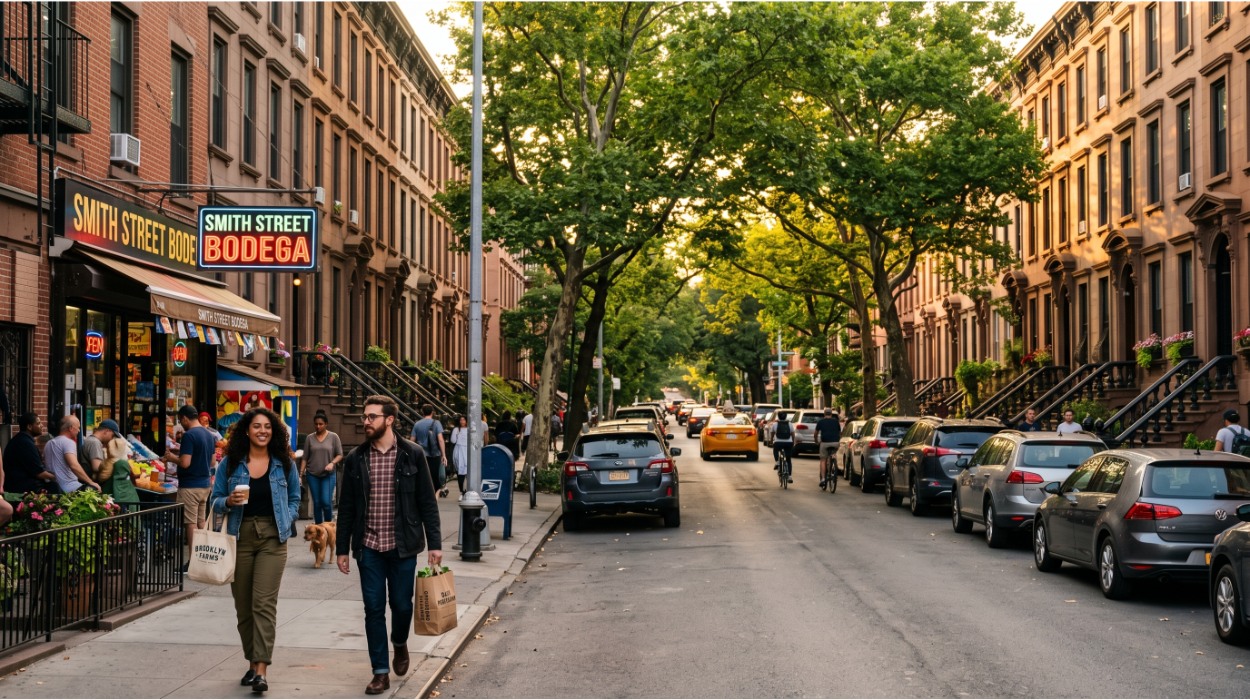
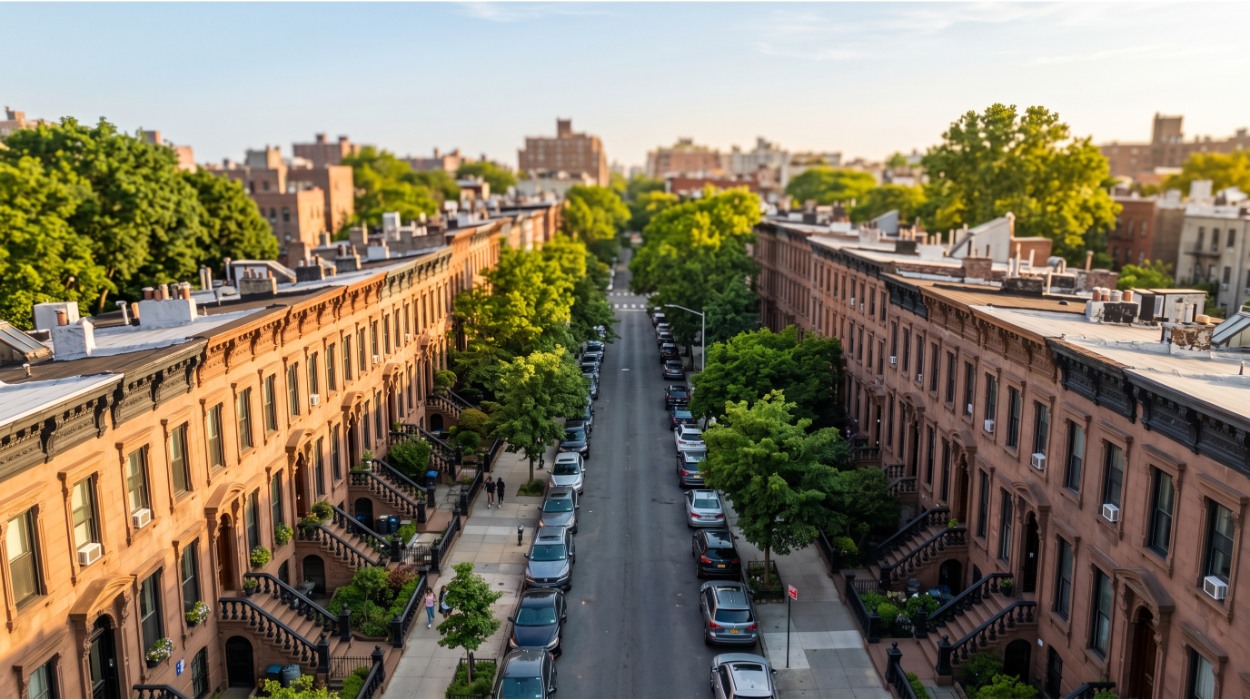

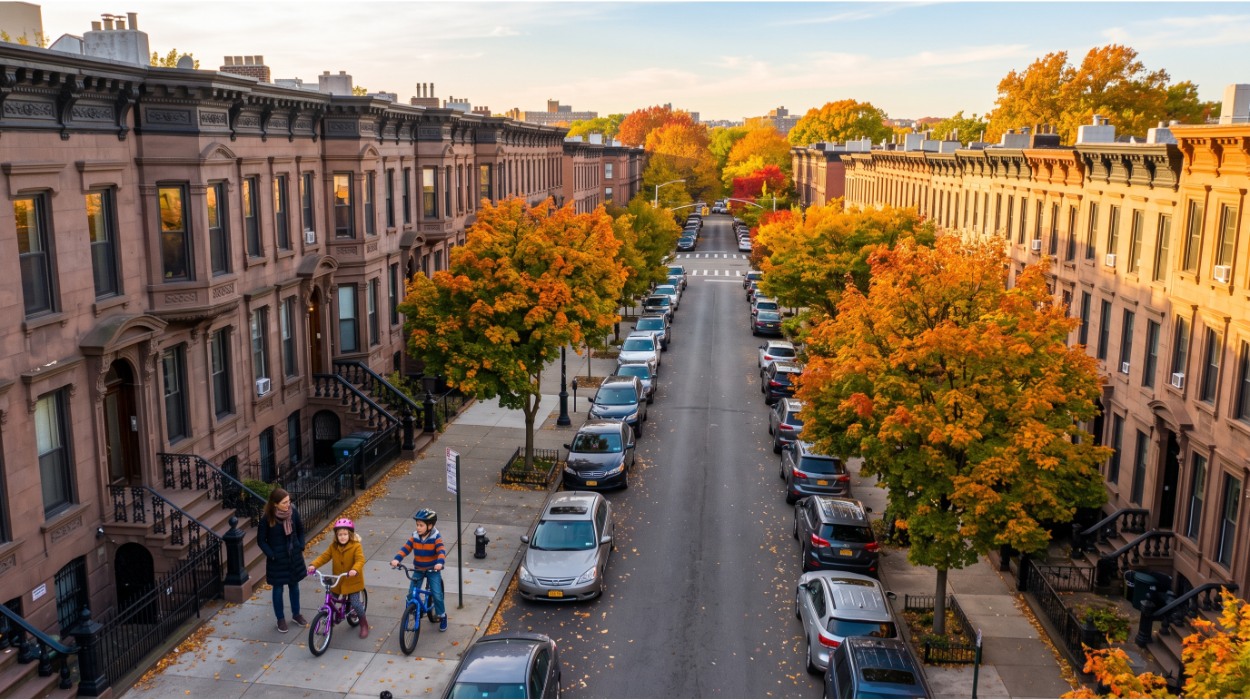
Brooklyn has over 70 neighborhoods, and your kid's school is determined by which side of the street you live on. NYC school zoning means your address is your school choice — one block can change your zoned elementary school, your commute options, and your childcare costs by over $1,000 per month. This guide covers what actually matters: commute, school quality, safety, and childcare cost.
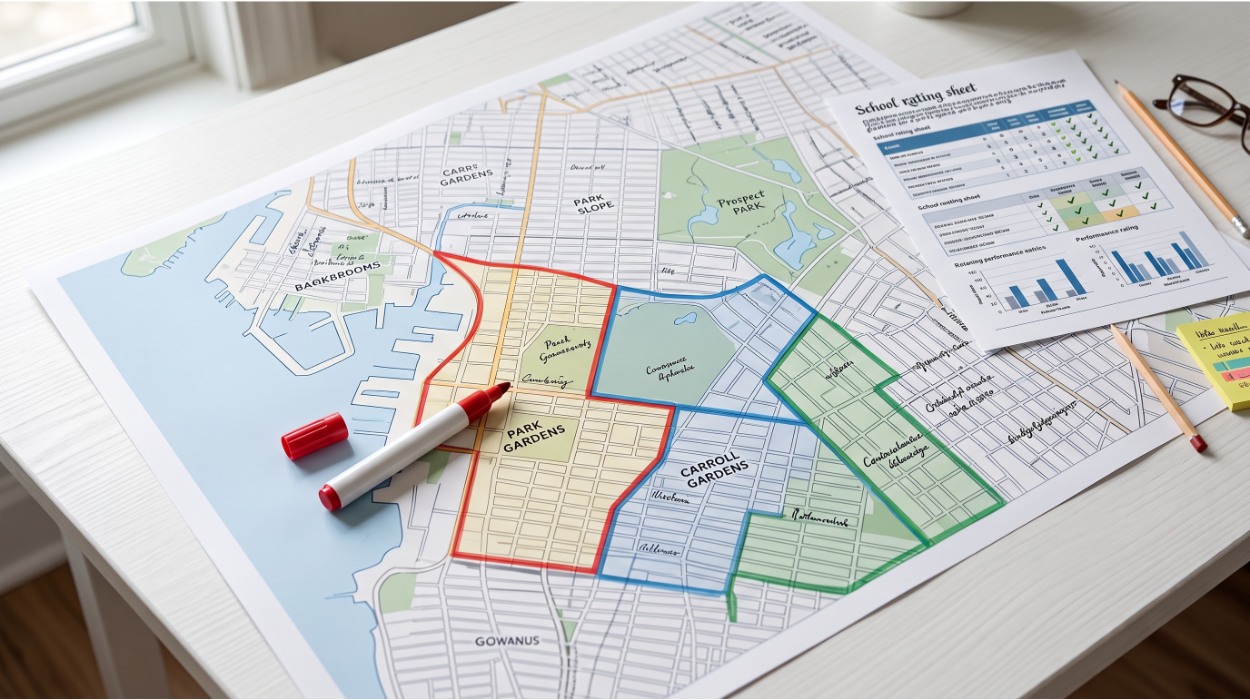
Before signing any lease, check your exact address against school zones at myschools.nyc. The Department of Education redraws boundaries periodically, so verify even if a friend on the same street confirmed their school last year.
How to Choose: The 4 Criteria That Actually Matter
Every guide to the best places to raise a family in Brooklyn lists the same neighborhoods. Most skip the trade-offs. Here's the framework for making an honest choice:
School quality. Ratings from LocalLogic's family composite (out of 10) reflect school test scores, parent reviews, and proximity to quality options. A 9.6/10 score isn't a label — it's the result of address-specific zoning. Always verify your specific address at myschools.nyc.
Commute time. Every extra 10 minutes of daily commute is 80+ hours per year — two full work weeks. The commute math compounds across years. The difference between an 18-minute and 45-minute commute is 1,800+ hours over a decade.
Childcare cost. The difference between Bay Ridge (~$1,300/mo) and Park Slope (~$2,900/mo) for infant care is roughly $19,200 per year. This single variable can determine which neighborhood is financially viable for your household.
Safety. Crime rates vary dramatically within Brooklyn. Use precinct-level data from the NYPD precinct crime stats for the specific blocks you're considering — borough-wide averages hide enormous variation.
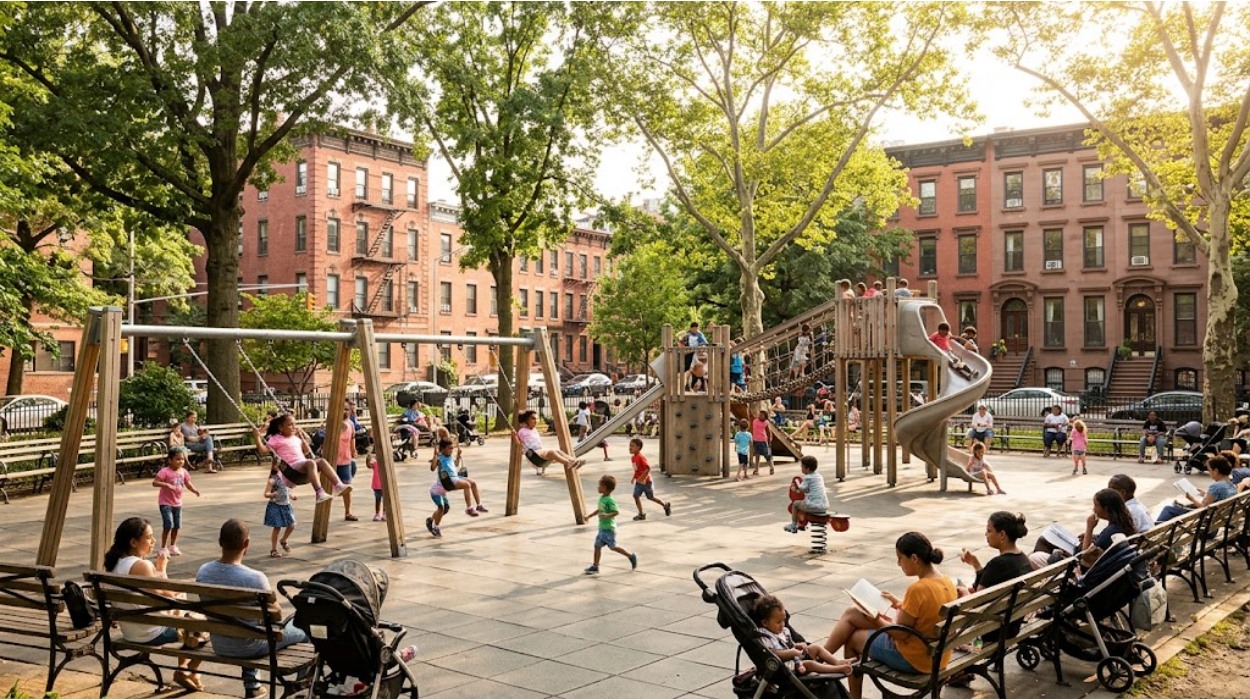
Park Slope: Brooklyn's Gold Standard for Families
Park Slope scores 8.9/10 on LocalLogic's family composite, with a perfect 10.0 walkability rating and 9.6/10 schools score. Every ranking of family friendly neighborhoods in Brooklyn starts here — and the numbers explain why.
Schools. PS 321 and PS 107 are among Brooklyn's top-rated elementary schools. Both are zoned, meaning your address determines eligibility. One block in the wrong direction puts you in a different school. MS 51 William Alexander serves as the strong middle school option. Confirm your zone at myschools.nyc before committing to any lease.
Prospect Park. 585 acres with a zoo, boathouse, nature center, and more playgrounds than you can visit in a month. The Grand Army Plaza Greenmarket runs year-round on Saturdays. The Park Slope branch of Brooklyn Public Library sits on the park's edge.
Commute. 25–35 minutes to Midtown via F, G, R, 2, or 3 trains. Multiple subway options mean you're not stranded if one line has problems. The 2/3 express from Bergen Street can cut Midtown trips to under 25 minutes during off-peak hours.
Cost reality. Park Slope brownstones and co-ops command premium prices well above Brooklyn's median. Childcare averages around $2,900 per month for infants and $2,200 for preschool. One practical note: brownstones don't have elevators. A stroller, toddler, and groceries on three flights of stairs is real — upper-floor units are priced lower for this exact reason.
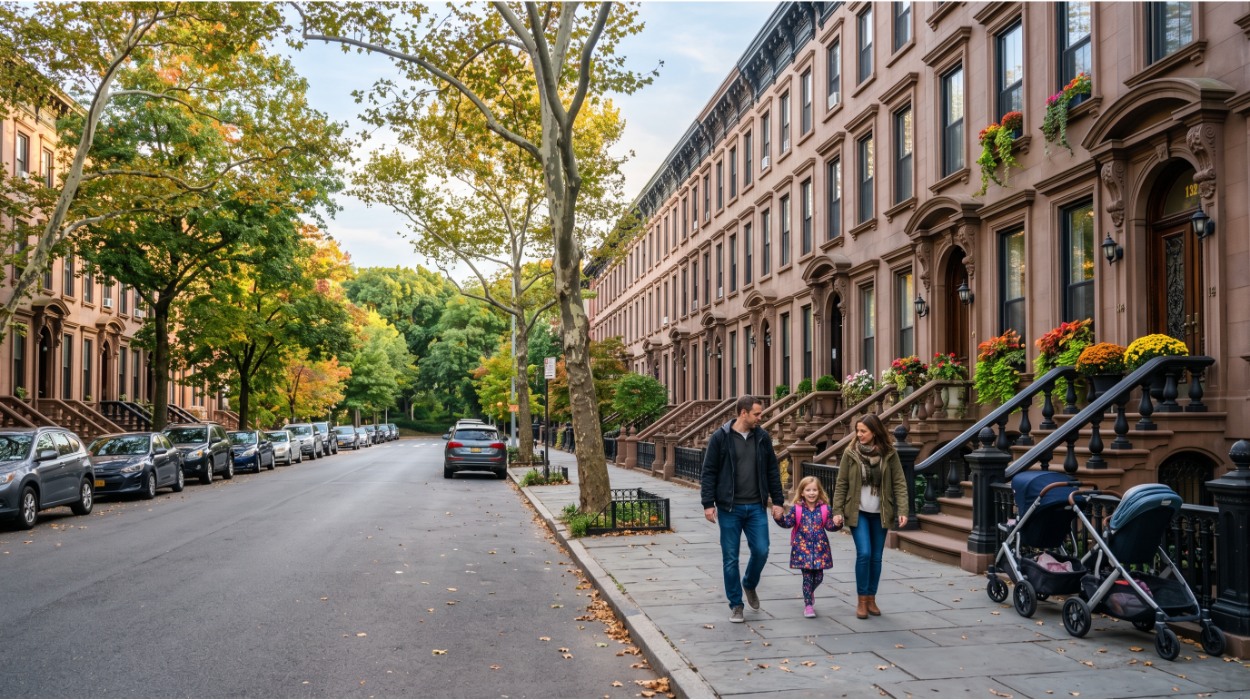
Brooklyn Heights: Fastest Commute and Safest Stats in Brooklyn
Brooklyn Heights puts you 18–22 minutes from Midtown Manhattan via the 2, 3, 4, 5, or R trains at Borough Hall. That's the fastest family-friendly commute in Brooklyn, and it's not close. Crime rates sit 52% below Brooklyn's average — the strongest safety stat of any neighborhood in this guide.
Family infrastructure. The Brooklyn Heights Promenade gives stroller-friendly waterfront paths. Pier 6 playground at Brooklyn Bridge Park is one of the best in the city — water features, slides, and sandbox areas for toddlers through age 10. Pier 2 adds roller skating and basketball. PS 8 Robert Fulton is the anchor elementary school, drawing from the high-performing District 13.
Cost reality. Brooklyn Heights is the borough's most expensive family neighborhood. The trade-off is the best commute-plus-safety combination in Brooklyn. That 18-minute commute adds meaningful hours back to your week, every week — over a year, you're reclaiming days of time that would otherwise vanish underground.
Neighborhood feel. Historic brownstone streets that are quieter than most of Brooklyn. Fewer restaurants and retail options than Park Slope — Montague Street is the main commercial strip. The Brooklyn Historical Society on Pierrepont Street runs kid-focused exhibits and weekend workshops.
Carroll Gardens: Deep Family Roots and Front-Stoop Community
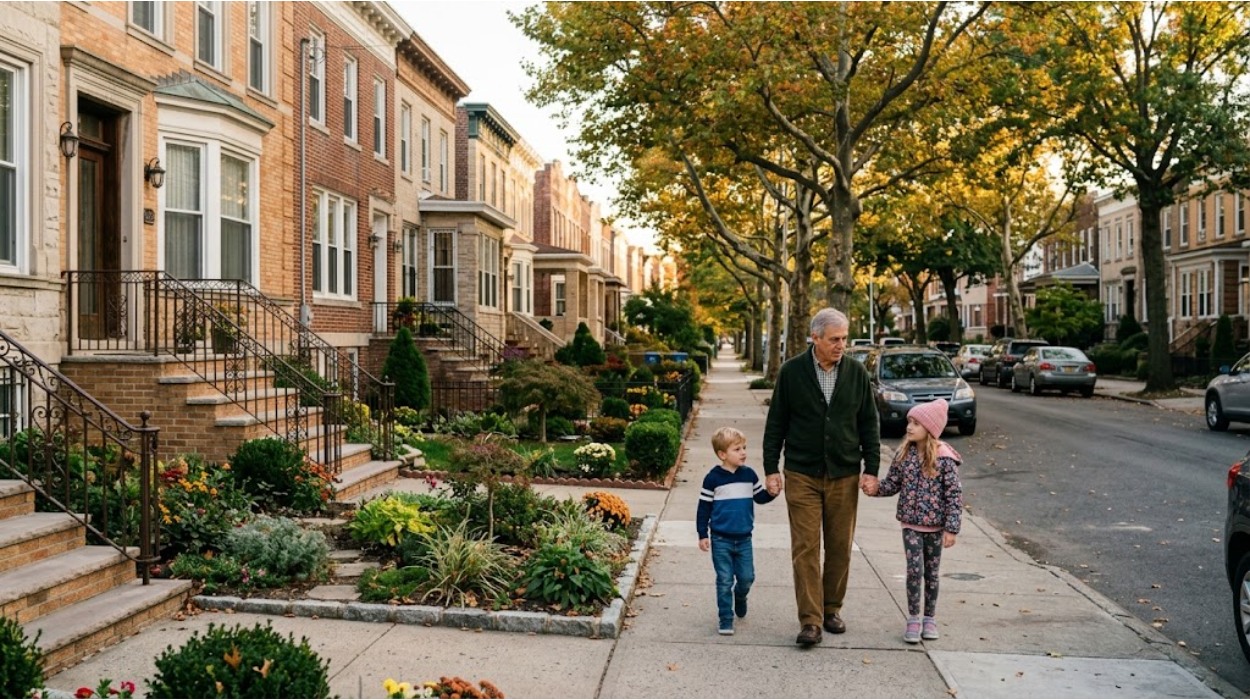
Carroll Gardens has something unusual for Brooklyn: front yards. Local zoning requires front garden setbacks, creating rows of stoops with planted gardens facing the sidewalk. Kids play on them. Parents talk across them. It builds street-level community that apartment-corridor neighborhoods can't replicate.
Community character. Deep Italian-American family roots going back generations. Multi-generational households aren't unusual. Carroll Park serves as the neighborhood gathering point with playgrounds, ball fields, and farmers market days. Smith Street provides a restaurant and café corridor with enough variety to avoid repetition.
Commute. 20–25 minutes to Midtown via F and G lines. The elevated Smith/9th Street platform has some of the best views of any subway station in the city.
Schools. Carroll Gardens sits within Brooklyn's strong brownstone school corridor. Adjacent Cobble Hill scores 9.6/10 on LocalLogic's schools metric, and the neighborhoods share overlapping school zones. PS 58 The Carroll School is the primary zoned option.
Windsor Terrace: Park Slope Quality at a Lower Price Point
Windsor Terrace borders Prospect Park on one side and Green-Wood Cemetery — a 478-acre national historic landmark with rolling hills, glacial ponds, and free family-friendly walking tours — on the other. Most guides to Brooklyn family neighborhoods skip Windsor Terrace entirely, which is exactly why it belongs here.
Family density. 24% of households have children — one of the highest rates in Brooklyn. You'll see it in stroller traffic on weekday mornings and full playgrounds on weekends. The neighborhood is built around family life, not just tolerant of it.
Schools and housing. Windsor Terrace falls within District 15, the same school district as Park Slope. PS 154 is the primary zoned elementary. Co-ops here are more accessible than Park Slope brownstones — pre-war co-ops and two-family homes dominate inventory at prices noticeably below northern neighbors. Check your specific address at myschools.nyc.
Neighborhood feel. Quieter and more residential than Park Slope. Fewer commercial strips and less foot traffic. Prospect Park West has local shops, a hardware store, and a couple of restaurants that function as neighborhood living rooms. If Park Slope sometimes feels like a small city, Windsor Terrace feels like a small town embedded within one.
Bay Ridge: Suburban Space and Brooklyn's Best Childcare Value
Infant childcare in Bay Ridge averages around $1,300 per month. In Park Slope, that number is roughly $2,900. Over a year, that's approximately $19,200 in savings. For families relocating from lower cost-of-living cities, that gap alone can determine which neighborhood is financially viable.
Safety. Bay Ridge is safer than 76% of NYC neighborhoods. The 68th Precinct has consistently reported very low serious crime rates — a stat that stands out in any borough.
Housing. Detached homes with actual yards are standard here, not exceptions. Average home prices are well below the brownstone belt, and you get significantly more square footage per dollar. Co-ops and condos along the avenues offer lower entry points for buyers not ready for a house.
Outdoor space. Shore Road Park runs along the waterfront for over four miles — strollers, bikes, and family walks all the way to Coney Island via the Belt Parkway bike path. Owl's Head Park adds ball fields, skate areas, and hilltop harbor views.
Commute trade-off. 35–45 minutes to Midtown via the R train local only — no express option. This is the price of Bay Ridge's affordability and space. Some commuters supplement with express bus service along Fourth Avenue.
The right agent in Brooklyn knows which school zone you're actually in — and which block to avoid near the BQE.
NestIt matches Brooklyn families with top local agents at lower commissions. No pressure, no commitment.
Mon – Sat · 9 AM – 7 PM ET
Crown Heights: Underrated Family Scores and Room to Grow
Crown Heights scores 8.9/10 on LocalLogic's family composite — identical to Park Slope. Its parks score of 9.8 actually beats Park Slope's 9.3. Most guides to Brooklyn neighborhoods for families skip Crown Heights entirely, which means less competition for housing and more value for families willing to look beyond the usual suspects.
Family infrastructure. The Brooklyn Children's Museum — the first children's museum in the United States — is here. Weeksville Heritage Center preserves one of the earliest free Black communities in pre-Civil War America and runs family programs year-round. Success Academy Crown Heights provides a charter school option.
Schools. 9.6/10 school score, matching Park Slope. Mix of zoned public schools, charter options, and private schools. Check myschools.nyc for address-specific zoning — parts of District 17 have no zoned schools in certain sections, making charter options especially important.
Commute. The 2, 3, 4, and 5 trains at Franklin Avenue and Nostrand Avenue provide express service to Midtown in roughly 30–40 minutes. The S shuttle connects to the B and Q at Prospect Park.
Neighborhood character. Culturally rich with deep Caribbean heritage — the annual West Indian Day Parade on Eastern Parkway is one of the largest in the world. Franklin Avenue has a commercial corridor with coffee shops, restaurants, and a weekend farmers market.
Ditmas Park: Victorian Homes and Yards Without Leaving Brooklyn
Ditmas Park has freestanding Victorian homes with wraparound porches and actual front yards — in Brooklyn. If you're relocating from a house-and-yard suburb and assumed Brooklyn meant apartments, this neighborhood will look the most familiar.
Housing. Victorian detached homes sell at prices below north Brooklyn averages. Many date to the early 1900s with original woodwork, stained glass, and generous lot sizes. Cost-per-square-foot consistently undercuts brownstone Brooklyn. Many of these homes have garages or off-street parking.
Commute. Q train express from Newkirk Plaza or Cortelyou Road to Midtown in roughly 35–45 minutes — one seat, no transfer required. Newkirk Plaza also serves the B train for additional routing options.
Neighborhood feel. Diverse community including Caribbean, South Asian, and Orthodox Jewish families. Cortelyou Road serves as the commercial spine with a weekly farmers market, independent bookstores, and the Flatbush Food Co-op. It has a village-center feel rare in Brooklyn.
Green space. Yards come with the homes — your kids have outdoor space without leaving the property. Prospect Park is accessible but not adjacent, roughly a 10–15-minute walk or short bike ride.
Marine Park: Maximum Space for Families Who Need a Car Anyway
Marine Park spans 798 acres — bigger than Prospect Park. The surrounding neighborhood feels more like Long Island than Brooklyn. If you already plan to own a car, this neighborhood rewards that decision instead of punishing it.
Housing. Detached homes with yards and driveways are the norm. This is the lowest price point on this list for single-family homes — the most square footage per dollar anywhere in Brooklyn. Cape Cod and ranch-style homes dominate, most with garages and private driveways.
Safety. Strong safety profile. Public service families from the NYPD and FDNY have historically concentrated here, contributing to a neighborhood watch culture that's organic rather than organized.
The commute reality. 45–60+ minutes to Midtown, bus-dependent to subway. The B2 and B31 buses connect to subway lines at Flatbush Avenue. If both parents commute to Manhattan daily, this gets hard. If one parent works remotely or commutes within Brooklyn, it's manageable.
Recreation. Marine Park has ball fields, tennis courts, a nature center, and a salt marsh preserve. Youth sports leagues run year-round. Gerritsen Beach adjacent adds kayaking and fishing access. Weekend beach trips to the Rockaways take about 20 minutes by car.
NYC School Zone Basics: What Every Brooklyn Family Needs to Know
NYC doesn't work like suburban school districts where the whole town shares one district. Your home address determines your zoned school — one block in the wrong direction can put you in a different elementary school entirely.
Use myschools.nyc to verify which schools serve your exact address. Do this before signing any lease — not after you fall in love with an apartment.
83% of families receive their first-choice school. 95% get one of their top three picks. Charter and unzoned schools can be applied to regardless of address.
The NYC DOE periodically redraws zone boundaries with limited notice. Families have moved specifically for a school zone only to get rezoned out. Never sign a long-term lease based solely on current zone boundaries.
For first-time buyers weighing Queens versus Brooklyn, see our guide to best neighborhoods in Queens for families and the NYC down payment assistance programs that apply across all five boroughs.
Frequently Asked Questions About Brooklyn Family Neighborhoods
How does NYC school enrollment work for families moving to Brooklyn?
Your home address determines your zoned school. Use myschools.nyc to look up which schools serve your exact address. Applications open in January for March offers. About 83% of families receive their first-choice school, and 95% get one of their top three picks. You can also apply to charter and unzoned schools regardless of address.
Can school zones change after we move to Brooklyn?
Yes. The NYC Department of Education periodically redraws zone boundaries, and changes can happen with limited notice. Families have moved specifically for a school zone only to get rezoned out. This isn't common, but it's a real risk. Don't sign a long-term lease based solely on the current school zone without understanding this possibility.
How much does childcare cost in Brooklyn?
It varies dramatically by neighborhood. Bay Ridge averages around $1,300 per month for infants. Park Slope averages around $2,900 per month. Carroll Gardens ranges from $2,325 to $4,500. Northern Brooklyn generally runs about $960 more per month at the median than southern Brooklyn. Over a year of infant care, the Bay Ridge vs. Park Slope gap is approximately $19,200.
What is the safest Brooklyn neighborhood for families?
Brooklyn Heights has the strongest safety stat in this guide at 52% below Brooklyn's average crime rate. Bay Ridge is safer than 76% of NYC neighborhoods. Park Slope runs 32% below the national average. Check precinct-level crime stats for the specific blocks you're considering — not borough-wide averages.
Do we need a car in Brooklyn with kids?
It depends on the neighborhood. Park Slope, Brooklyn Heights, Carroll Gardens, and Crown Heights are fully functional without a car. Windsor Terrace and Ditmas Park are manageable. Bay Ridge benefits from having one. Marine Park essentially requires one for daily life — the commute is bus-dependent and the lifestyle is car-optimized.
When is the best time to apartment hunt in Brooklyn with kids?
Start looking in late winter for a summer move. Most NYC leases turn over between June and September, so inventory peaks in spring. Searching January through March gives you the widest selection for a summer start date, which aligns with the school year.