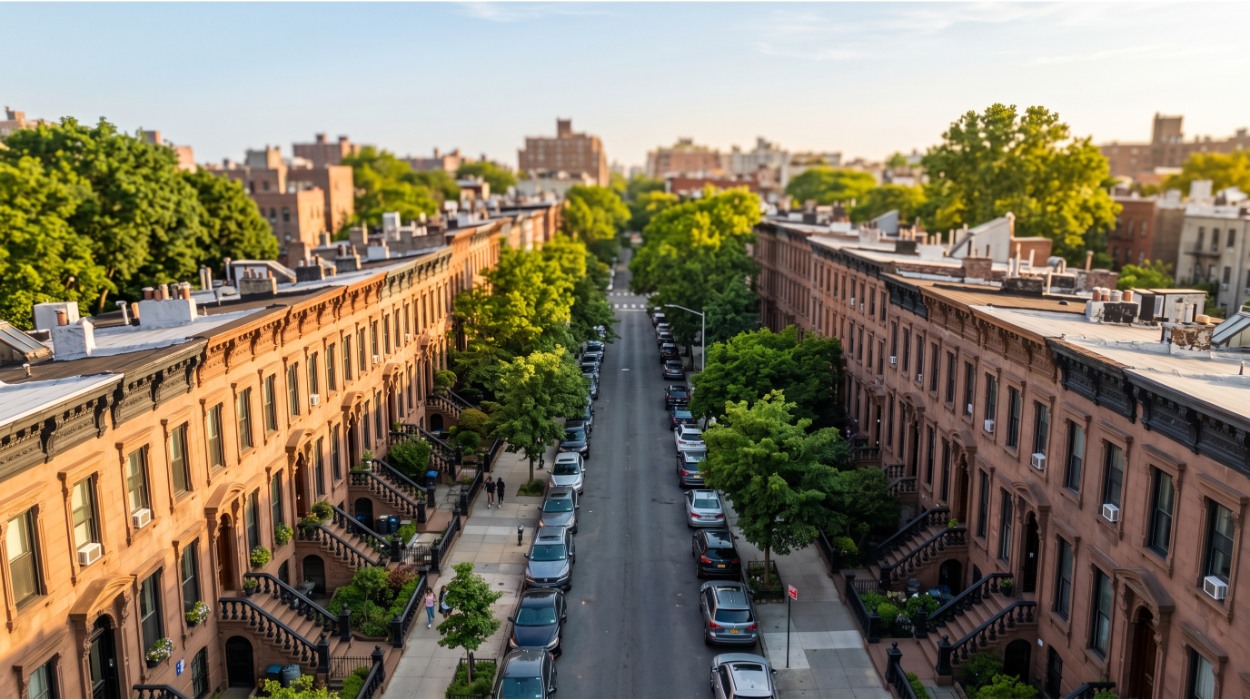


If you own a house or an apartment in Queens, Brooklyn, or anywhere else in the city, there's a decent chance you've gotten a postcard, a text, or a cold call promising a fast, no-hassle cash offer. Some of those come from national tech companies called iBuyers. Some come from local investors who buy distressed property to flip. And a smaller, darker slice come from people trying to steal your home outright. Telling the three apart, and understanding how each one actually prices an offer, is the difference between a convenient sale and a costly mistake.
An iBuyer, short for "instant buyer," is a company that uses an automated valuation model and a team of local buyers to make you a direct cash offer on your home, skip the showings and financing contingencies, and let you pick the closing date. It sounds tailor-made for a city where listings can sit through months of open houses and board packages. In practice, the model runs into real friction here: it was built for tract-house suburbs with deeds, comparable sales, and fast title transfers, not for a market dominated by co-op boards, meaningful transfer taxes, and hyper-local micro-neighborhoods.
This guide covers what an iBuyer actually is and how it prices your home, what the major players charge, which ones currently document coverage anywhere near New York City, why co-ops in particular don't fit the model, how "we buy houses" investors differ from iBuyers, and the deed-theft protections and Attorney General warnings you should know about before you sign anything that transfers your home.
What Is an iBuyer, and How Are Offers Priced?
An iBuyer is a company, not an individual investor, that buys your home directly with its own capital, then resells it later, usually after light repairs and restaging. You never list the home publicly, and there are no buyer showings. The company takes on the resale risk itself: if the market moves against it before it can resell, the loss belongs to the iBuyer, not to you.
Pricing starts with an automated valuation model built on recent comparable sales in your area, adjusted for your home's size, condition, and features, sometimes confirmed with a video or in-person walkthrough. Across the industry, iBuyers typically offer 85-95% of a home's fair market value before fees.3 That range, not a flat percentage below "asking price," is the real starting point for comparing an iBuyer offer against a traditional sale.
After you accept a preliminary offer, most iBuyers send someone to inspect the property in person. Needed repairs, from a leaking roof to outdated wiring, get priced out and subtracted from your final proceeds at closing, so the number you see on day one is rarely the number you net.
iBuyer Fees: What You Actually Net
On top of pricing below fair market value, every iBuyer charges a service fee, deducted from your proceeds at closing rather than billed separately.
| Company | Service fee | What the company says |
|---|---|---|
| Opendoor | Not a fixed rate; shown in your individual offer | Opendoor says the fee varies by market and property and describes it as comparable to what many sellers pay in agent commission on a traditional sale.2 |
| Offerpad | 5% | Offerpad describes this as a single, simple service fee with no separate commission stacked on top.1 |
Neither fee is the whole cost. Repair deductions found during inspection, any remaining mortgage payoff, and normal seller closing costs, including New York's transfer taxes, still come out of your proceeds the same as they would in a traditional sale. Treat the headline offer as a starting number, not a net-proceeds number.
Which iBuyers Actually Buy Homes in the NYC Area Today
Opendoor is the iBuyer most likely to come up if you search for a cash offer in New York. Its own market-launch coverage names a New York footprint of Nassau, Orange, Rockland, Suffolk, and Westchester counties, more than 230 ZIP codes across Long Island and the Lower Hudson Valley.4 That is the documented direct-buy service area, and it stops short of the five boroughs.
Property type matters too. Opendoor buys single-family homes and townhomes outright; condo eligibility depends on the specific building, HOA, and market and isn't guaranteed; co-ops don't appear among the property types Opendoor lists as eligible at all.5
Offerpad, the other large national iBuyer, does not operate in New York in any form. Its own locations page lists Arizona, Florida, Georgia, Indiana, Nevada, North Carolina, Ohio, South Carolina, and Texas as its markets, with no New York presence.6
A fast cash offer trades certainty for equity, so run the real net-proceeds math before you sign anything.
Talk through your sale with an agent, or request a free valuation of your NYC home.
Mon – Sat · 9 AM – 7 PM ET
What Happened to Zillow Offers, and Why It Matters
Zillow Offers, once the most visible name in iBuying, no longer exists. In November 2021, Zillow's board decided to wind the business down, cutting about 25% of the company's workforce, roughly 2,000 employees, in the process.7
CEO Rich Barton pointed to the core weakness of the whole model: the company couldn't reliably forecast home prices, and the business wasn't built to absorb that kind of earnings and balance-sheet volatility.7 By the time the shutdown was announced, Zillow had more than 10,000 homes sitting in inventory and ultimately took a write-down of more than $500M tied to the closure.7 The wind-down was completed in 2022. Redfin closed its own iBuyer, RedfinNow, that same year, pointing to similar losses from pricing risk rather than a New York-specific problem.
The lesson for a seller isn't that iBuyers are dishonest. It's that the pricing model itself is fragile, sensitive to market swings that can move faster than an algorithm can reprice, and that even the best-funded company in the space walked away from it entirely once the numbers stopped working.
Why Co-ops Are a Poor Fit for iBuyers
Buying a co-op apartment in New York doesn't get you a deed. It gets you shares of stock in the cooperative corporation that owns the building, plus a proprietary lease that gives you the right to occupy your specific unit. Selling means transferring those shares and reassigning that lease, and almost every co-op building requires its board to approve the buyer before the sale can close.
That approval process, an application, financial documentation, and typically an in-person interview, sits entirely outside the seller's or the iBuyer's control. A board can reject a buyer, and in most buildings it doesn't have to explain why. An iBuyer's entire pitch rests on pricing certainty and a fast, predictable closing on real property with a deed; a sale that can be vetoed by a private board at the last stage of the process breaks that model at the root. It's a large part of why co-ops don't appear on the published eligibility list for buying with Opendoor.5
If you're weighing a cash offer against a traditional listing for a co-op specifically, the trade-offs are different enough from a condo or house sale that they deserve their own comparison; see our co-op vs. condo selling guide for the board-approval and share-transfer details that apply regardless of who's buying.
Local Cash Buyers and 'We Buy Houses' Investors vs. iBuyers
"We buy houses" companies and local cash investors are a different business entirely from an iBuyer, even though the pitch, a fast cash offer with no repairs, sounds similar. Investors buy property in any condition, foundation issues, fire damage, deferred maintenance, because they plan to renovate and resell for a profit, and that plan is priced into the offer.
| Buyer type | Typical offer vs. fair market value | Condition required |
|---|---|---|
| National iBuyer | 85-95%, before the service fee3 | Near move-in ready; priced by algorithm and comps |
| Local "we buy houses" investor | 50-70% of after-repair value3 | Any condition, including major damage |
The gap exists because the two buyer types build their margin differently. An iBuyer prices close to market and recovers its margin through the separate service fee described above. An investor skips the fee and instead bakes a much larger discount directly into the purchase price, since renovation, holding costs, and resale risk all have to come out of that spread.3
Since no major national iBuyer currently documents direct-buy coverage inside the five boroughs, most of the unsolicited "cash offer" mail, texts, and door-knocks that reach city homeowners come from this investor category, not from an Opendoor- or Offerpad-style platform. That distinction matters when you're deciding how much room there is to negotiate, or whether the offer is worth entertaining at all.
New York's Deed-Theft Protections and Attorney General Warnings
Deed theft happens when someone forges a deed to make it look like they legitimately purchased a home, or tricks a homeowner into unknowingly signing away title, then tries to sell the property to a third party or evict the real owner.10 It is a distinct crime from a bad cash-offer deal, but the two overlap in practice: predatory operators often use the language and pressure tactics of a legitimate instant offer to get a signature.
The New York Attorney General's office has said it receives 3-4 reports of deed theft a week, concentrated in Brooklyn, Queens, Northern Manhattan, and the Bronx.10 In response, the state strengthened its legal protections: legislation known as S.6577/A.6656, signed by Governor Hochul on November 14, 2023, made deed theft prosecutable as a distinct crime with escalating degrees, gave the Attorney General concurrent jurisdiction to prosecute cases, created a civil mechanism to flag a property's records and block fraudulent sales or loans, and allows pausing related eviction proceedings while a deed-theft claim is investigated.89
None of this means a cash offer from a legitimate company is a scam. It means the same warning signs, pressure to sign quickly, discouraging you from getting independent advice, vague or shifting paperwork, apply whether the "buyer" is a real iBuyer, a real investor, or someone after your title outright.
How to Compare a Cash Offer Against Listing Your Home
Run the comparison on net proceeds, not on the headline number. A cash offer nets you roughly 85-95% of fair market value, minus the service fee described earlier, minus any repair deductions found at inspection.3 A traditional listing nets you closer to full market value, minus your agent's commission, minus normal closing costs, minus the time and uncertainty of showings and negotiation. For a full breakdown of what a traditional sale actually costs in New York City today, see our guide to the cost of selling a home in NYC.
New York's transfer taxes apply either way, since they're triggered by the sale itself, not by who buys. New York City's Real Property Transfer Tax runs 1% of the price on sales at or below $500,000, and 1.425% above that, for one-, two-, and three-family homes and individual condo units.11 On top of that, New York State charges a transfer tax of $2 per $500 of the price, roughly 0.4%, and adds a 1% mansion tax that the buyer typically pays once a residential sale reaches $1 million or more.12
Timeline is the other half of the math. A cash offer can close in a matter of weeks with a fixed date you choose. A traditional listing's timeline depends heavily on your borough, price point, and whether you're selling a co-op with board approval built in; see how long it typically takes to sell a house in NYC for the real ranges. If you're weighing whether to skip an agent altogether rather than take a discounted cash offer, our FSBO in NYC guide covers that middle path. Whichever direction you're leaning, get an independent, no-obligation home valuation before you accept any cash number, so you have a real market baseline to measure it against.
Red Flags and Questions to Ask Before You Accept a Cash Offer
- Pressure to sign the same day, or before you've had a chance to talk to a real estate attorney.
- No verifiable company name, license, or local address behind the offer, just a phone number or a P.O. box.
- Paperwork described as "temporary," or a request to sign over your deed or shares outside of a real closing with a title company or attorney present.
- A buyer who discourages you from getting an independent valuation or a second opinion before you sign.
- An offer that arrives with no walkthrough, no comparable-sales explanation, and no written breakdown of fees or deductions.
Before you accept anything, ask for the offer in writing with every deduction itemized, ask who is handling the closing and confirm it's a licensed title company or attorney, ask what could change the number between now and closing, and ask directly whether the company is a licensed real estate broker in New York.
If any of this feels off, stop and contact the Attorney General's office at 1-800-771-7755 or deedtheft@ag.ny.gov before you sign anything that transfers your home.10
Frequently Asked Questions
What exactly does "iBuyer" mean?
It's short for "instant buyer": a company that uses an automated valuation model and local staff to make you a direct cash offer on your home, buy it with its own capital, and resell it later, instead of listing it for you on the open market.
Do Opendoor or Offerpad buy homes directly in NYC's five boroughs?
Not based on either company's own published coverage. Opendoor's documented New York footprint is Nassau, Orange, Rockland, Suffolk, and Westchester counties.4 Offerpad doesn't operate in New York State at all.6 Neither lists Brooklyn, Queens, Manhattan, the Bronx, or Staten Island as part of its direct-buy service area.
Can I get an iBuyer offer on my co-op apartment?
It's unlikely. Co-ops don't appear on Opendoor's published list of eligible property types, unlike single-family homes and townhomes.5 The board-approval process built into every co-op sale also runs against the fast, certain closing an iBuyer's model depends on.
How much less will I net with a cash offer than by listing?
As a starting point, national iBuyers typically offer 85-95% of fair market value before their service fee,3 and "we buy houses" investors typically offer just 50-70% of a home's after-repair value.3 An independent home valuation is the fastest way to see what the gap looks like for your specific property.
What happened to Zillow Offers? Is it coming back?
Zillow shut the business down starting in November 2021, cut about 25% of its workforce in the process, and took a write-down of more than $500M once the wind-down was completed in 2022.7 There's no indication the company is planning to relaunch it.
Are "we buy houses" investors the same thing as iBuyers?
No. iBuyers are large tech companies that price close to market value using algorithms and comparable sales, then charge a separate service fee. Local "we buy houses" investors typically offer 50-70% of after-repair value with no separate fee, building their entire profit margin into that lower price.3
What should I do if I suspect a deed-theft or cash-offer scam?
Stop before you sign anything, and contact the New York Attorney General's deed theft hotline at 1-800-771-7755 or deedtheft@ag.ny.gov.10 State law also lets prosecutors pause related eviction proceedings while a deed-theft claim is investigated.9
Do I still need a real estate attorney if I sell for cash?
Yes. New York closings, cash or otherwise, are handled with an attorney representing each side, and skipping that step to speed up a cash sale removes one of your main protections against a bad or fraudulent deal.