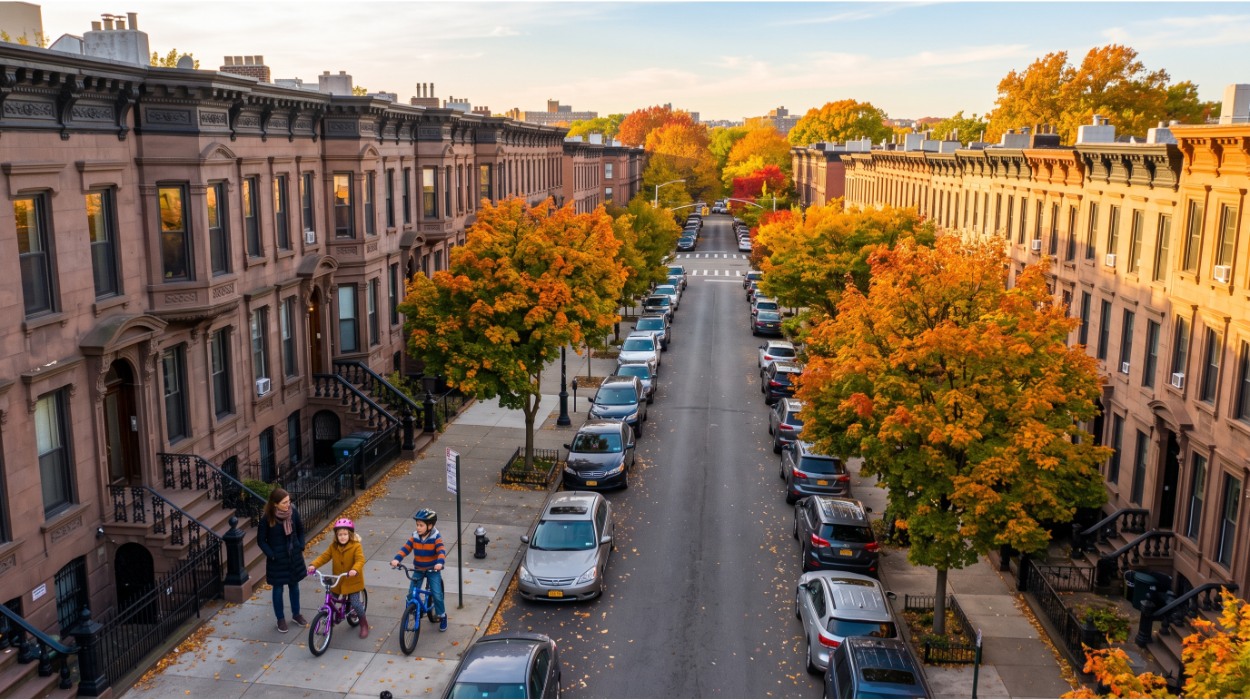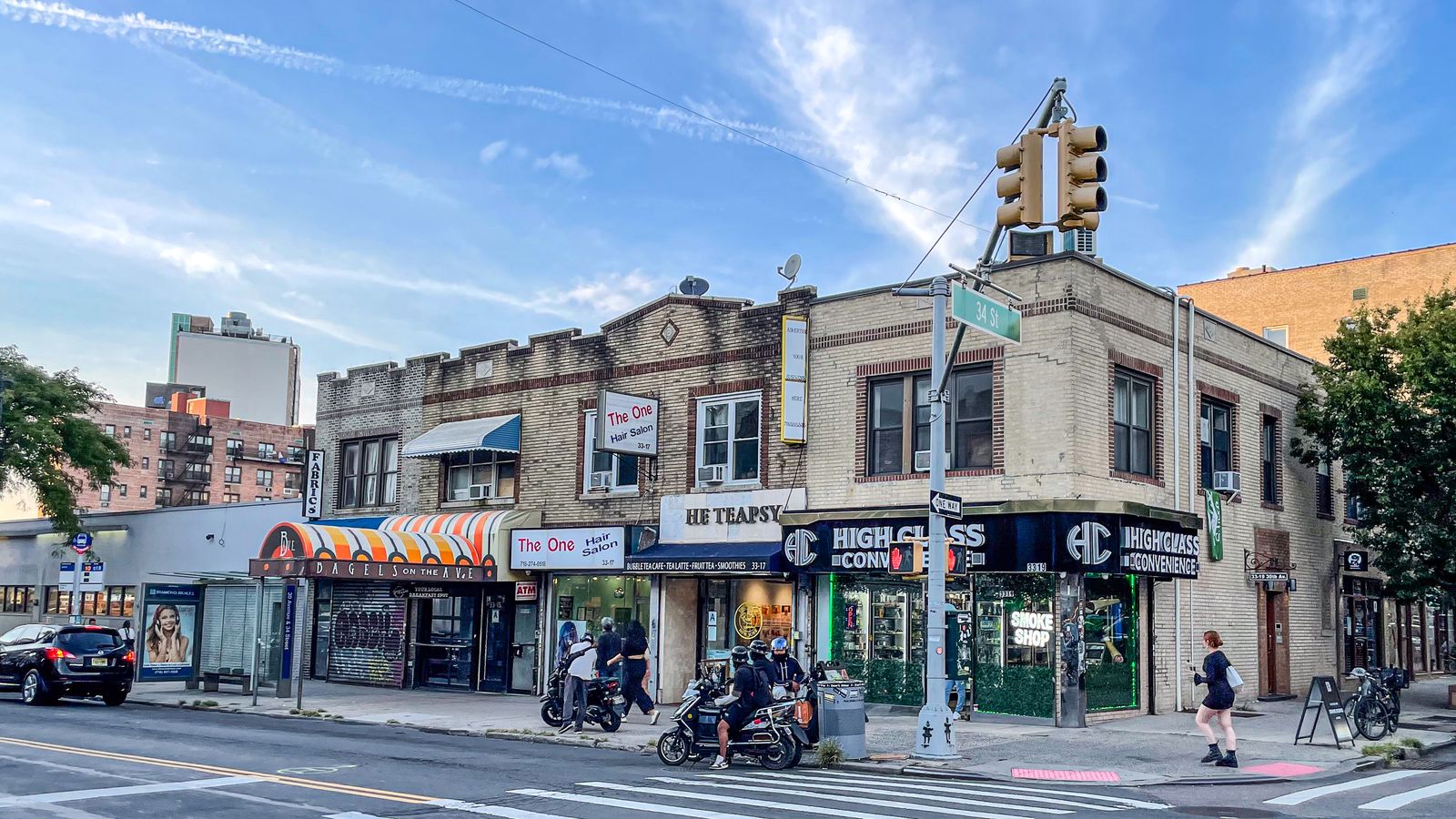

Yes — Queens is generally safe. With a violent crime rate of 3.25 per 1,000 residents (vs. NYC's borough averages of 5.43 in Brooklyn and 5.80 in Manhattan), Queens ranks as the second-safest borough in New York City, ahead of Brooklyn, the Bronx, and Manhattan overall. The safest neighborhoods — Bayside (1.2), Douglaston, and Little Neck (both under 1.5) — sit significantly below even that borough average.
Here are the seven safest neighborhoods in Queens, ranked by violent crime rate per 1,000 residents:
- Bayside: 1.2
- Douglaston: less than 1.5
- Forest Hills: 1.8
- Fresh Meadows: 2.4
- Kew Gardens: 2.7 (property crime metric)
- Little Neck: less than 1.5 (shares 111th Precinct with Douglaston)
- Middle Village: 3.2
All seven sit below the Queens borough average of 3.25 per 1,000.
Queens already ranks as NYC's second-safest borough. Its violent crime rate of 3.25 per 1,000 compares favorably to Brooklyn (5.43) and Manhattan (5.8). Crime across the borough fell 6.4% in 2025, continuing a multi-year downward trend. If you are narrowing your NYC search to a single borough, Queens gives you the best ratio of safety to affordability. For a full breakdown by commute, lifestyle, and price, see our guide to the best neighborhoods in Queens NY.
There is a trade-off. The safe neighborhoods in Queens with the lowest crime tend to lack subway access. Forest Hills and Kew Gardens are the exceptions, with express E and F service to Midtown in under 30 minutes. Bayside, Douglaston, and Fresh Meadows rely on LIRR or buses instead. Every neighborhood below includes transit details so you can weigh safety against commute time before making a decision. If you are still deciding on an area, our guide to the best places to live in Queens covers lifestyle, price, and commute factors side by side. For a full picture of what buying here costs, see our Queens homes for sale guide.
Is Queens Safe? Here's What the Data Shows
Yes, Queens is safe — and by a meaningful margin compared to most NYC boroughs. Its 2024 violent crime rate of 3.25 per 1,000 residents puts it well ahead of Brooklyn, Manhattan, and the Bronx. Only Staten Island scores lower at 2.28 per 1,000.
Here is how Queens compares to every other NYC borough across three key crime metrics:
| Borough | Violent Crime Rate (per 1,000) | Safer than Queens? |
|---|---|---|
| Queens | 3.25 | — |
| Brooklyn | 5.43 | No |
| Manhattan | 5.80 | No |
| Bronx | 9.28 | No |
| Staten Island | 2.28 | Yes |
Source: NYPD CompStat 2024 annual data. Violent crime = murder, rape, robbery, and felony assault per 1,000 residents.
Queens is approximately 40% less violent than Brooklyn and 45% less violent than Manhattan. If you are relocating from either of those boroughs, moving to Queens is a statistically significant safety upgrade, not just a minor step.
That said, "Queens is safe" is not a complete answer. The borough covers 109 square miles and 2.3 million people across neighborhoods that vary wildly in crime level — use our Queens neighborhood guide to orient yourself geographically before narrowing your search. Northwest Queens (Flushing, Jamaica, South Jamaica) accounts for the majority of the borough's crime volume. Northeast Queens, where most of the safest areas in Queens cluster, logs a fraction of that total.
The practical takeaway: picking the right neighborhood inside Queens matters more than simply choosing Queens over another borough. That is what the rest of this guide covers.
Bayside: The Safest Neighborhood in Queens by the Numbers
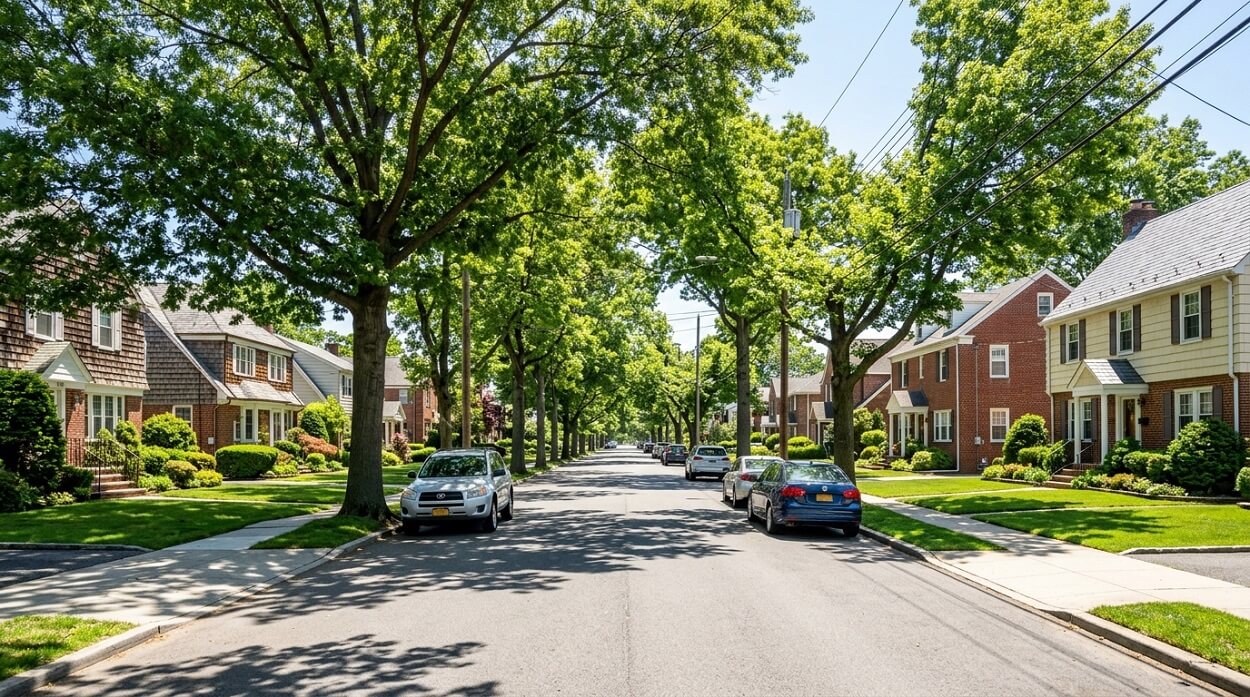
One murder. That is the total for the entire 111th Precinct in 2024. The precinct covers Bayside, Douglaston, and Little Neck, and it posted a 10.2% overall crime drop that same year.
Bayside's violent crime rate sits at approximately 1.2 per 1,000 residents. The Queens average is 3.25. That gap is the widest of any neighborhood on this list, and it has remained consistent for several years running.
Part of the explanation is cultural. Bayside has one of the densest populations of city cops, firefighters, and service workers in Queens. These residents have a direct stake in community safety, and it shows in the numbers. The neighborhood's residential density and low commercial foot traffic also suppress opportunistic crime.
What you will pay. The median home sale price ranges from $826K to $904K as of mid-2026. Co-ops start around $175K for studios, giving budget-conscious buyers a real entry point. Single-family homes run from $1.15M to $2.5M depending on lot size and renovation status. If you are renting, expect $1,400 to $1,600 per month for a one-bedroom — notably below the Queens borough average of $3,453.
Getting to work. There is no subway in Bayside. You rely on the LIRR Port Washington Branch, which gets you to Penn Station in 24 to 28 minutes with trains every 30 minutes during peak hours. A monthly pass runs $198 to $220, with a 10% discount for city residents. A car is essential for grocery runs, school drop-offs, and weekend errands.
Schools. PS 203 Oakland Gardens ranks 15th in NYC and 27th in New York State, with 68% actual proficiency against a 50% projected benchmark. Bayside High School ranks 65th statewide. GreatSchools gives the Bayside district strong marks across elementary and middle school levels. More than half of NYC's top 50 K-8 schools cluster in northeast Queens, and Bayside anchors that zone.
Green space. Cunningham Park (358 acres) and Alley Pond Park (655 acres) border the neighborhood. Both offer trail systems, sports fields, playgrounds, and nature preserves. Alley Pond includes the Queens Giant, believed to be the oldest living thing in New York City.
Best for: Families with school-age kids, remote workers, and buyers who rank safety above everything else.
Skip if: You need a subway commute or want nightlife within walking distance.
Douglaston: Quietest Street Grid in Queens
Douglaston is one of the few places in New York City where you can live on a dead-end street with a front yard, a two-car garage, and a top-rated public school three blocks away. It shares the ultra-low-crime 111th Precinct with Bayside and Little Neck, posting a violent crime rate below 1.5 per 1,000 residents.
What makes Douglaston different from Bayside is the street layout. The neighborhood sits on a peninsula bordered by Little Neck Bay and Udalls Cove, which means most streets dead-end at the water. There is no cut-through traffic. No late-night commuter foot traffic. The geography itself acts as a crime deterrent.
Violent crime has held below 1.5 per 1,000 residents for more than five years straight, making Douglaston one of the most consistently safe neighborhoods in Queens.
What you will pay. Douglaston runs expensive. The median sale price hit $955K in September 2025, up sharply year over year. Zillow pegs the average home value at $1,198,273. The housing stock is almost entirely single-family homes with driveways and yards. Rental inventory is near-zero. If you are looking to rent, Douglaston is not the neighborhood. If you are buying and can clear $1M, it is one of the best long-term value plays in northeast Queens. For full context on where Douglaston sits within Queens' luxury tier, see our guide to the most expensive neighborhoods in Queens.
Getting to work. LIRR Douglaston station (Port Washington Branch) gets you to Penn Station in under 30 minutes. Express buses (Q12, Q30, QM3, QM5, QM8) serve local trips. The Long Island Expressway and Cross Island Parkway are close for drivers. There is no subway.
Schools. PS 98 Douglaston School ranks 41st in NYC. JHS 67 Louis Pasteur ranks 27th among NYC middle schools. Families move here for these schools and rarely leave, which keeps the neighborhood stable and inventory tight year after year.
Best for: Buyers above $1M who want maximum quiet, strong schools, and a true suburban feel without leaving city limits.
Skip if: You rent, commute by subway, or want walkable restaurants and nightlife.
Little Neck: The Easternmost Safe Area in Queens
Little Neck sits at the far northeastern tip of Queens, right on the Nassau County border. It shares the 111th Precinct with Bayside and Douglaston, which puts its violent crime rate in the same under-1.5 per 1,000 range. The neighborhood gets less press than its neighbors but delivers the same safety numbers with a slightly lower price point.
The combination of the Nassau County line, Little Neck Bay, and the area's predominantly homeowner base keeps crime low and foot traffic quiet. Like Douglaston, there is no real commercial strip generating late-night activity. The safest areas in Queens tend to share this pattern: low transient traffic, high homeownership, and a residential street grid with limited through-routes.
What you will pay. Little Neck median home prices run close to Douglaston but slightly lower, reflecting its smaller footprint and fewer waterfront lots. Expect $900K to $1.1M for single-family homes. Like Douglaston, rental inventory is thin. The neighborhood skews heavily toward owners.
Getting to work. LIRR Little Neck station (Port Washington Branch) mirrors the Douglaston commute: under 30 minutes to Penn Station. The same buses (Q12, Q30) serve both neighborhoods. No subway access.
Schools. PS 94 David D. Porter ranks among the top 55 elementary schools in New York State. The district feeds into the same northeast Queens middle and high school pipeline as Douglaston and Bayside.
Best for: Buyers who want Douglaston-level safety with a slightly lower price tag.
Skip if: You need subway access or want a walkable neighborhood with restaurants and retail.
Forest Hills: The Best Subway Access Among Queens' Safest Areas
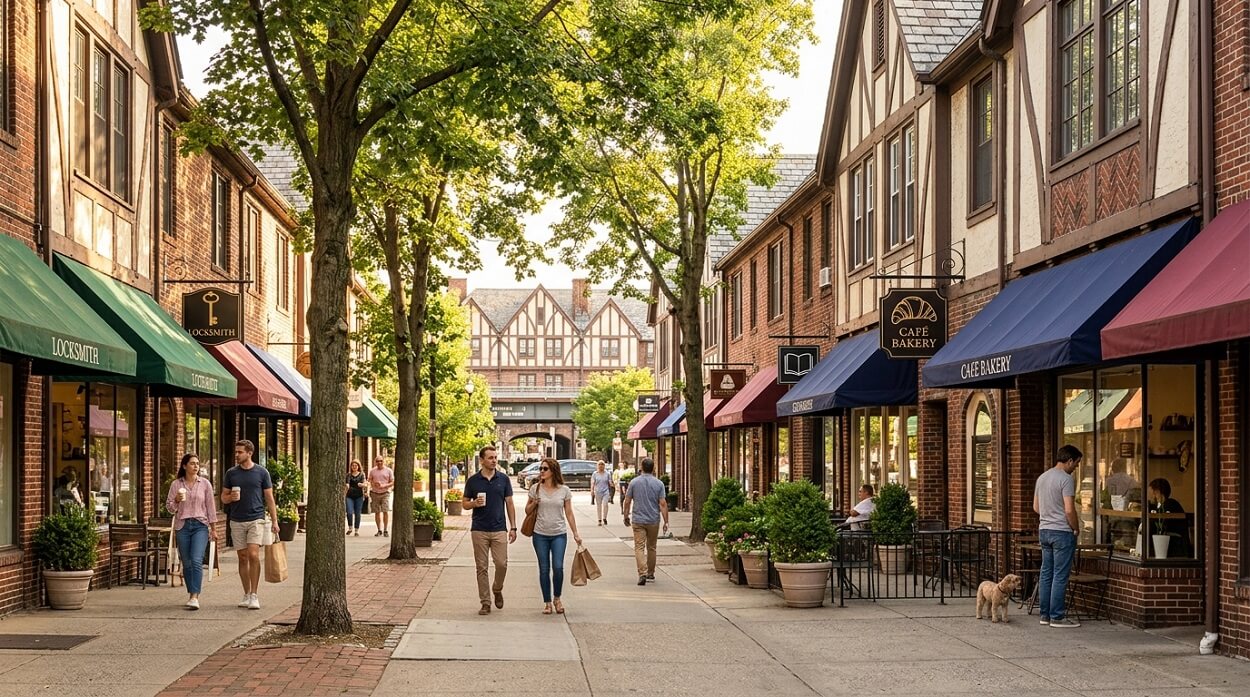
Forest Hills is the only neighborhood on this list with four subway lines and a crime rate under 2.0 per 1,000 residents. Crime ticked up 5.1% in 2025. That deserves context.
A violent crime rate of 1.8 per 1,000 still sits comfortably below the Queens average of 3.25. The 5.1% uptick came off a very low base: two murders in 2025 compared to zero in 2024. That is a statistical blip in a small-population precinct, not a neighborhood in decline. NeighborhoodScout ranks Forest Hills safer than 78% of all U.S. neighborhoods.
What you will pay. The median sale price hovers around $450K, driven by a co-op-heavy market where studios start at $199,999. One-bedroom rentals average $2,300 per month, still below the Queens average of $3,453. Detached single-family homes cross the $1M mark, especially in the Gardens section. The wide price range makes Forest Hills accessible to renters, first-time co-op buyers, and established homeowners alike.
Getting to work. This is where Forest Hills separates itself from every other neighborhood on this list. The E, F, M, and R subway lines serve three stations along Queens Boulevard. The LIRR Forest Hills station adds another option. Expect 15 to 25 minutes to Midtown via express subway or LIRR.
The neighborhood decides your safety. The agent decides your price. Get both right.
NestIt matches you with a top Queens agent who knows every precinct, every block — at a lower commission than you'd pay anywhere else.
Mon – Sat · 9 AM – 7 PM ET
Schools. Forest Hills High School ranks 36th in New York State. District 28 serves the neighborhood with strong elementary options. PS 144 earns top parent ratings consistently.
Neighborhood character. Forest Hills Gardens is a historic planned community established in 1909, built in Tudor Revival style with private streets maintained by a homeowners' association. Homes in the Gardens rarely hit the open market, and when they do, they command premiums above $2M — placing it among the most expensive neighborhoods in Queens. Austin Street serves as the main shopping and restaurant corridor. Forest Park (538 acres) borders the neighborhood to the south.
Fresh Meadows: 85th Percentile Safety at Mid-Range Prices
Fresh Meadows ranks in the 85th percentile for safety among all U.S. neighborhoods. Not just NYC. The entire country. The New York Post named it the safest NYC neighborhood in 2022, and the numbers have held steady since. If the price point here appeals to you but you also want to understand the luxury end of the Queens market, our most expensive neighborhoods in Queens guide covers Fresh Meadows in that context too.
The 107th Precinct logged 982 incidents in 2025, holding stable year over year. The violent crime rate sits at 2.396 per 1,000 residents. That is still well below the Queens average of 3.25 and dramatically below Brooklyn's 5.43. Crime here has been flat, not rising, which is the pattern you want to see in a neighborhood you are buying into for the long term.
What you will pay. One-bedroom rentals range from $2,200 to $2,800 per month, making this more affordable than Bayside for renters. Median home listings land around $1.16M for houses, but co-ops and condos bring the entry point down considerably. The Fresh Meadows Housing Development, a large co-op complex built in the 1940s, anchors the affordable end of the market.
Getting to work. This is the main drawback. Fresh Meadows has no direct subway or LIRR service. The Q17, Q25, and Q34 bus routes connect you to Flushing, where you transfer to the 7 train for Manhattan access. Total commute to Midtown runs 50 to 70 minutes depending on transfers and wait times. Car ownership is strongly recommended.
Community character. The neighborhood is quiet, residential, and diverse. Cunningham Park (358 acres) borders the area, shared with Bayside. The planned residential layout keeps streets predictable and walkable. Local retail clusters along 188th Street and Union Turnpike.
Best for: Car owners or remote workers who want 85th-percentile safety without the Bayside or Douglaston price tag.
Skip if: You commute daily to Manhattan by subway. Forest Hills or Kew Gardens will serve you better.
Kew Gardens: Pre-War Charm With Express Train Safety
Kew Gardens gives you express subway access and a $700K median home price in a neighborhood where property crime sits at 2.7 per 1,000. That combination does not exist anywhere else on this list.
The 102nd Precinct covers Kew Gardens, and the property crime rate falls well below Queens averages. Queens Borough Hall anchors the neighborhood, bringing a steady presence of police, civic workers, court personnel, and attorneys. That institutional foot traffic adds a layer of passive security during business hours that most residential neighborhoods lack.
What you will pay. The median home price is approximately $700K. Detached homes range from $1.2M to $1.6M, concentrated on the quieter blocks south of Queens Boulevard. Pre-war co-ops and some condos are available below $700K, making this more affordable than Forest Hills for comparable transit access. One-bedroom rentals typically fall between $1,800 and $2,400 per month.
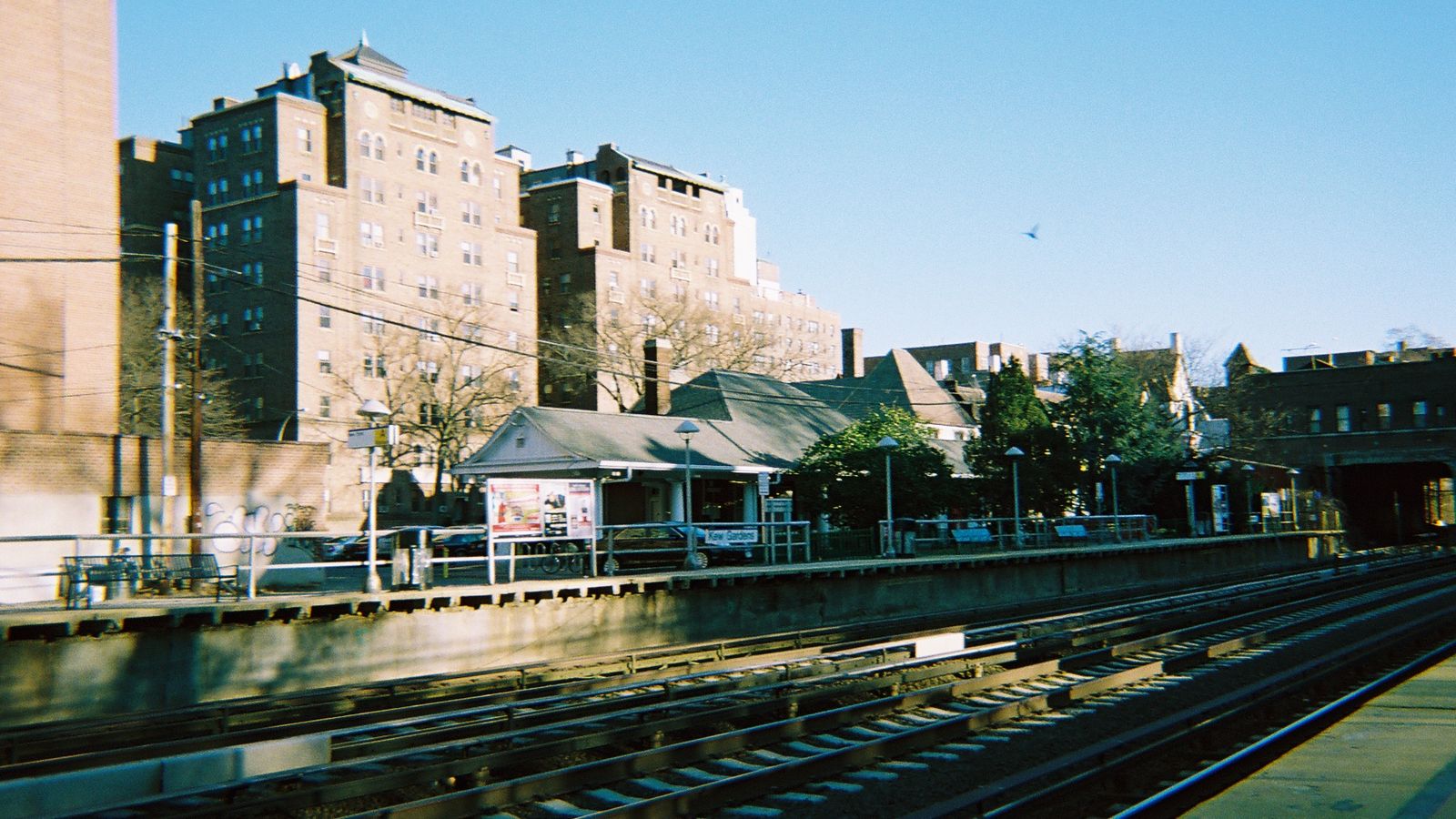
Getting to work. The E and F express subway lines stop here, along with a LIRR station at Kew Gardens. Expect 25 to 35 minutes to Midtown. The LIRR option adds redundancy on days when subway service runs delayed. Multiple bus routes cover local connections, and the Van Wyck Expressway provides direct highway access for drivers heading to JFK Airport or Long Island.
Neighborhood character. Pre-war architecture lines the tree-shaded streets north and south of Queens Boulevard. This housing stock, mostly built in the 1920s and 1930s, attracts buyers who want character that postwar construction does not offer. Forest Park sits nearby, shared with Forest Hills. Lefferts Boulevard anchors the local dining and retail scene with a growing mix of restaurants, cafes, and independent shops.
Best for: Commuters who want express subway access at a lower buy-in than Forest Hills.
Skip if: You need the absolute lowest crime rate. Look at Bayside instead.
Middle Village: Tight-Knit Community With Below-Average Crime
Middle Village has the highest crime rate on this list at 3.2 per 1,000. It is still safer than Queens as a whole. That tells you how high the bar is for every neighborhood covered here.
The 104th Precinct reports a violent crime rate of 3.219 per 1,000 and a property crime rate of 5.976 per 1,000. Both sit below the Queens borough average. Long-term residents and an active community watch culture help keep numbers in check. The neighborhood's relatively isolated street grid, bordered by cemeteries on two sides, limits pass-through traffic and keeps the area insular.
What you will pay. Middle Village offers one of the most affordable entry points among the safest neighborhoods in Queens NY. The co-op market is strong, and multi-generational homeownership keeps inventory tight. Prices generally run 15% to 25% below comparable properties in northeast Queens neighborhoods like Bayside and Douglaston. Single-family homes that would list above $1.2M in Bayside often price under $1M here.
Getting to work. The M subway line stops at Metropolitan Avenue, giving you direct service to Manhattan. That puts Middle Village ahead of Bayside, Douglaston-Little Neck, and Fresh Meadows for subway riders. Bus routes along Metropolitan Avenue and Eliot Avenue add local flexibility.
Community character. This is a tight-knit neighborhood with Italian and Eastern European heritage running through multiple generations. Juniper Valley Park (53 acres) serves as the community anchor, with ball fields, a running track, tennis courts, and a popular farmers' market in summer. Metropolitan Avenue doubles as the main retail corridor with bakeries, delis, and hardware stores that have operated for decades.
Best for: Buyers who want community roots and affordability without crossing into high-crime territory.
Skip if: You want the absolute lowest crime numbers or need express subway service.
Safety Factors to Consider When Choosing a Queens Neighborhood
Crime rates are the starting point, not the finish line. Here are the factors that actually determine whether a specific block in Queens will feel and be safe for you.
NYPD Precinct Crime Data
Every Queens address falls inside one of the borough's precincts. Precinct-level data from NYPD CompStat is updated weekly and breaks crime into seven categories: murder, rape, robbery, felony assault, burglary, grand larceny, and grand larceny auto. Look at all seven, not just the headline total. A precinct can have low overall crime but a spike in one category, as northeast Queens demonstrated in 2024 with a 70% year-over-year increase in rape incidents despite the 111th Precinct's overall 10.2% crime drop.
Homeownership Rate
Neighborhoods with high homeownership tend to have lower crime. Owners have financial skin in the game: they maintain properties, know their neighbors, and engage with community boards. Bayside, Douglaston, and Little Neck have some of the highest homeownership rates in Queens, which directly correlates with their consistently low crime numbers over multiple years.
Transit Hub Proximity
Major subway stations and bus terminals generate foot traffic around the clock, including late-night activity that can attract opportunistic crime. Forest Hills manages this well because its residential streets sit several blocks from the transit hub at Forest Hills-71st Avenue. When touring apartments, check how far the unit sits from any major subway entrance or bus depot.
Commercial Density
Dense commercial strips create more foot traffic, which can go either way. Austin Street in Forest Hills stays safe because of active business improvement district patrols and a well-lit corridor. Avoid blocks directly adjacent to 24-hour bodegas, check-cashing shops, or liquor stores if minimizing property crime exposure is a priority.
Building-Level Security
Even in the safest precincts, individual buildings vary significantly. A doorman building in the 111th Precinct is safer than a walk-up with a broken vestibule lock. When evaluating apartments, check for: controlled key-fob entry, working intercoms, security cameras covering the lobby and side entrances, and adequate exterior lighting.
Community Engagement
Active neighborhood associations and community boards are a reliable proxy for safety. Queens Community Board 11 covers northeast Queens (Bayside, Douglaston, Little Neck, Auburndale, Fresh Meadows, Whitestone). Boards that meet regularly, respond to 311 complaints, and maintain communication with the local precinct produce safer neighborhoods.
School Quality as a Stability Signal
Neighborhoods with highly-rated public schools attract stable, long-term resident families, which keeps turnover low and community investment high. Low turnover is one of the most reliable predictors of sustained low crime. It is why Bayside and Douglaston have maintained their safety records for decades, not just a single good year.
Is Queens Safe at Night?
Most of Queens is safe after dark, particularly the northeastern neighborhoods — Bayside, Douglaston, and Little Neck see low incident rates day and night, and their quiet residential streets rarely generate after-hours concerns. Forest Hills, Astoria, and Flushing are active at night with restaurants, bars, and foot traffic, and are generally safe for walking.
The picture changes in parts of Southeast Queens. Areas around Jamaica and South Jamaica see higher late-night incident rates. If you are in those areas after midnight, avoid walking alone on side streets. The pattern tracks with the daytime crime data — the same neighborhoods that rank high during the day see elevated numbers at night.
Practical rule: if a neighborhood is on this list, it is safe at night. If it is not on this list, look up the precinct's complaint data before drawing conclusions.
Frequently Asked Questions
What is the safest neighborhood in Queens NY?
Bayside and Douglaston-Little Neck share the title. Both fall under the 111th Precinct, which recorded just 1 murder in all of 2024. Bayside posts a violent crime rate of 1.2 per 1,000 residents, and Douglaston-Little Neck comes in below 1.5. No other Queens neighborhood matches those numbers. For context, the Queens borough average is 3.25 per 1,000, and Brooklyn sits at 5.43.
Is Queens safe for families with kids?
Yes, especially northeast Queens. The area combines low crime with top-rated schools. PS 203 in Bayside ranks 15th in NYC. Bayside High School ranks 65th in New York State. Forest Hills High School ranks 36th statewide. Niche.com gives Bayside schools an A+ rating with 68% proficiency against a 50% projected benchmark. Low crime plus strong schools makes northeast Queens one of the strongest family markets in the city.
Is Queens safer than Brooklyn?
By the numbers, yes. Queens posts a violent crime rate of 3.25 per 1,000 residents compared to Brooklyn's 5.43 and Manhattan's 5.8. Queens crime also dropped 6.4% overall in 2025. The safest Queens neighborhoods like Bayside (1.2 per 1,000) post rates that are roughly 4.5 times lower than Brooklyn's borough average. The gap is significant enough to factor into any borough-level decision.
Do I need a car to live in the safest parts of Queens?
It depends on the neighborhood. Bayside, Douglaston-Little Neck, and Fresh Meadows have no subway access, so a car is strongly recommended. LIRR monthly passes run $198 to $220 for those areas, but you still need a car for errands, school pickups, and weekend activities. Forest Hills (E/F/M/R) and Kew Gardens (E/F express) offer full subway commutes to Midtown in 15 to 35 minutes. Middle Village has M line service. If subway commuting is non-negotiable, your safest options are Forest Hills and Kew Gardens.
How much does it cost to rent in the safest Queens neighborhoods?
One-bedroom rents range from $1,400 to $1,600 per month in Bayside up to approximately $2,300 in Forest Hills. Fresh Meadows falls in the $2,200 to $2,800 range. Kew Gardens runs $1,800 to $2,400. All of these sit below the Queens borough average of $3,453 for a one-bedroom apartment. Co-op purchases start as low as $175K in Bayside and $199K in Forest Hills for studios, making ownership cheaper than renting in some cases.
How do I check crime stats for a specific Queens neighborhood?
Three free tools give you neighborhood-level data. The NYPD CompStat website (nyc.gov/nypd/stats) breaks crime down by precinct and updates weekly. The NYC Crime Map lets you search by address and filter by crime type and date range. CrimeGrade.org provides letter grades by neighborhood with year-over-year trend data. Match your target address to its precinct number for the most accurate comparison.
Is Douglaston safe?
Yes. Douglaston is one of the safest neighborhoods in Queens. It falls under the 111th Precinct, which recorded just 1 murder for all of 2024 across the entire precinct area. Violent crime runs below 1.5 per 1,000 residents. The neighborhood's peninsula geography limits through-traffic and transient activity, which keeps crime consistently low year over year.
Is Queens safe at night?
Northeast Queens neighborhoods (Bayside, Douglaston, Little Neck, Forest Hills) are quiet and safe at night. These are predominantly residential areas with low nighttime foot traffic and good street lighting. Forest Hills' Austin Street corridor stays active into the evening with restaurants and shops, and it remains well-patrolled. For new residents, avoid late-night walks near major transit hubs in western Queens (Jamaica, Flushing main corridors) until you are familiar with the area.
What is the most dangerous neighborhood in Queens?
Northwest Queens sees significantly higher crime than the rest of the borough, with approximately 14,283 crimes per year compared to 2,795 in northeast Queens. The NYPD 103rd Precinct (Jamaica) and 113th Precinct (South Jamaica) consistently rank among the borough's highest-crime precincts. These areas sit at the opposite end of the spectrum from the safe neighborhoods in Queens covered in this guide.
Which Queens precinct has the lowest crime?
The 111th Precinct, headquartered in Bayside, consistently posts the lowest crime numbers in Queens. It covers Bayside, Douglaston, Little Neck, Auburndale, Hollis Hills, and Fresh Meadows. In 2024, it recorded just 1 murder, 9 rapes, 57 robberies, and 96 felony assaults across the entire precinct area, while posting a 10.2% overall crime drop year over year.
Is Queens safe compared to other NYC boroughs?
Queens is the second-safest borough in New York City. Its violent crime rate of 3.25 per 1,000 residents sits well below Brooklyn (5.43), Manhattan (5.80), and the Bronx (9.28). Only Staten Island (2.28) posts lower violent crime. Queens crime also declined 6.4% overall in 2025. For buyers and renters comparing boroughs, Queens wins handily over three of the other four on safety.